Digital Transformation of Process Industries: From Manual Adjustment to Intelligent Optimization
In process industries such as chemical engineering, oil refining, and fine
chemicals, the complexity of plant operation is constantly increasing. Problems
such as multivariate coupling, dynamic operating condition changes, and
multi-objective balancing make traditional manual adjustment and single-loop PID
control increasingly inadequate for modern production requirements. While
pursuing high quality, low energy consumption, and high output, enterprises also
need to cope with increasingly stringent environmental regulations and market
competition pressures:
1. Multivariate coupling leads to insufficient system stability:
Traditional single-loop PID control struggles to effectively handle the
interactive effects of multiple variables. Changes in raw material composition
and catalyst degradation further exacerbate system fluctuations, forcing
operators to adopt conservative strategies, sacrificing production efficiency to
maintain stability.
2. Difficulty in balancing multi-objective optimization: Product quality,
energy efficiency, production output, and environmental compliance are
interdependent. Increasing purity requires increased energy consumption, while
reducing costs may affect quality. Traditional methods often lead to suboptimal
operation, failing to fully unleash the plant's potential.
3. Lack of predictive capability and lagging risk management: Feedback
control models can only correct problems after they occur; minor anomalies can
easily escalate into serious malfunctions, increasing the risk of downtime.
4. Enterprises struggle to respond quickly to energy price fluctuations and
market changes.
Advanced Process Control (APC) can transform passive response into
proactive optimization.
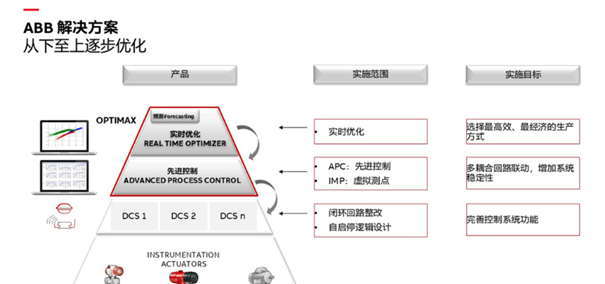
APC is an intelligent optimization system running on top of DCS
(Distributed Control System). It uses data and models to predict the future and
automatically calculates the optimal operating strategy. ABB Ability™ OPTIMAX
APC is a market-proven APC solution that achieves intelligent optimization
through four technological pillars:
1. Predictive Analysis and Fluctuation Elimination through Model Predictive
Control (MPC)
Accurate process models predict system behavior in the future and
proactively adjust parameters based on the predictions, resolving problems
before they occur.
2. Multi-Variable Collaborative Optimization, Holistic Consideration, and
Decoupling
Multiple variables are considered holistically within a single framework.
Complex devices such as distillation columns, reactors, and utilities can
operate in a coordinated manner, resolving the mutual influence between multiple
variables.
3. Real-Time Economic Optimization, Smart Decision-Making, and Increased
Profitability
Based on current operating conditions, energy prices, and market demand, it
automatically finds the most economical operating point. It adapts flexibly,
ensuring operation close to the optimal point. 4. Fully Integrated Architecture,
Seamless Integration, Reduced Risk
Seamless integration with existing DCS, SCADA, and SIS systems, coupled
with digital twin technology support, allows for repeated verification of
solutions in a virtual environment, reducing risk.
Optimization of the Methanol Distillation Unit at Yunnan Dawei Coking
Plant
The methanol distillation unit at Yunnan Dawei Coking Plant plays a crucial
role in purifying crude methanol into refined methanol. Fluctuations in feed
composition lead to unstable product purity, high steam consumption, and
difficulties in manual adjustment due to the mutual influence of multiple tower
systems.
ABB implemented the OPTIMAX® APC multivariate predictive control system,
covering key processes such as the pre-distillation tower, pressurized tower,
and atmospheric tower, achieving multi-tower collaborative optimization. The
project achieved the following results:
• Increased methanol production and yield
• Significantly reduced steam consumption
• Reduced operating parameter fluctuations by over 30%
• High utilization rate of the APC system
Understanding the APC Implementation Path?
APC implementation is not a one-step process, but a phased approach—from
plant assessment, value analysis, pilot validation, to expanded deployment and
continuous optimization. You can learn more about the specific roadmap and
success factors through the ABB APC e-book.
Start Your Smart Optimization Journey
Driven by carbon neutrality goals and digital transformation, industrial
process control is entering a new phase. The shift from reactive problem-solving
to proactive smart optimization has become an inevitable trend. ABB OPTIMAX® APC
helps companies achieve improved plant stability, optimized energy efficiency,
and optimized economic benefits through predictive control and collaborative
optimization technologies.
Recommended related products:
S-093N 3BHB009885R0001
UMP3009 TRICONEX
TRICONEX TCM 4355X
TRICONEX TCM4355X
MP 3009 TRICONEX
3009 TRICONEX
51454926-176 FC-SCNT01
51454926-176 FC-SCNT02
GE 151X1235DB15NP03
GE 151X1235DB10SA01
GE 151X1235DB15SA03
GE 151X1207DC13SA21
GE 151X1235DB15SA01
151X1235BC01SA01 GE
GE 151X1233DB01SA01R3
GE 151X1233DB01SA01R4
GE 151X1233DB01SA01R
GE 151X1235DB15SA02
GE 151X1235DB15SA01
GE 151X1235DB15SA01
S-093N 3BHB009885R0021
ABB 3BHB009885R0001
More......


 ABB
ABB GE
GE HONEYWELL
 TRICONEX
 KONGSBERG
 EMERSON
 FOXBORO
 MOTOROLA
 VIBRO-METER
 ICS TRIPLEX
 WOODWARD
 BENTLY NEVADA
 OTHER
OTHER Home
Home 2026/04/13
 4779
4779