Please note that all products on this
website are specialty items, and market prices are constantly
fluctuating.
The exact price quoted by customer
service will prevail, as the price may not be accurate for new
products.
Please confirm the model, product,
price, and other detailed information with customer service before placing an
order. This website is currently in use.
New items are available for sale; please
contact customer service for further information.
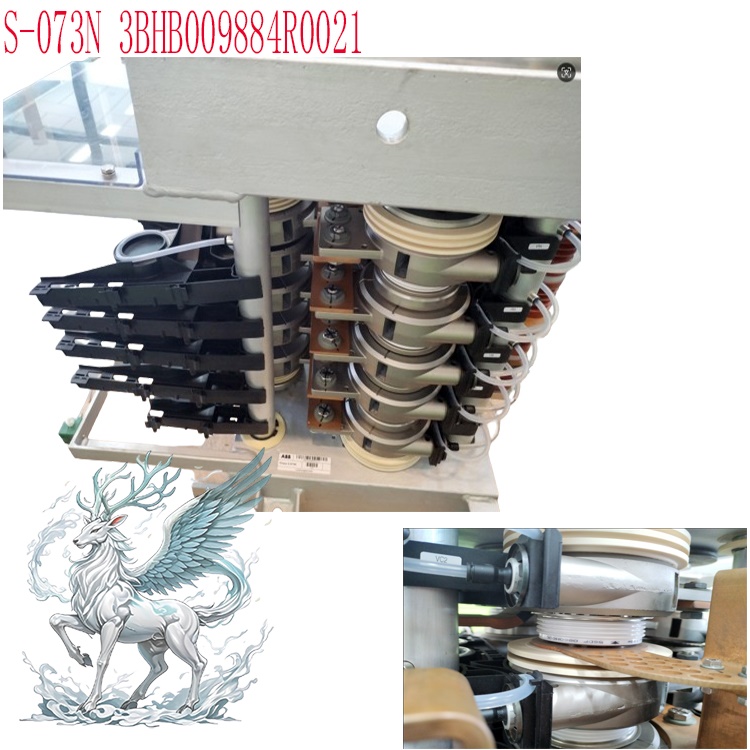
S-093N 3BHB009885R0021 Other Names:
ABB High Voltage Inverter
Rack PCS6000 Inverter
Phase Module S-093N 3BHB009885R0021
S-093N 3BHB009885R0021 ACS6000 Inverter
Phase Module
Product
Positioning and Core Technology
.jpg)
System
Affiliation:
Model
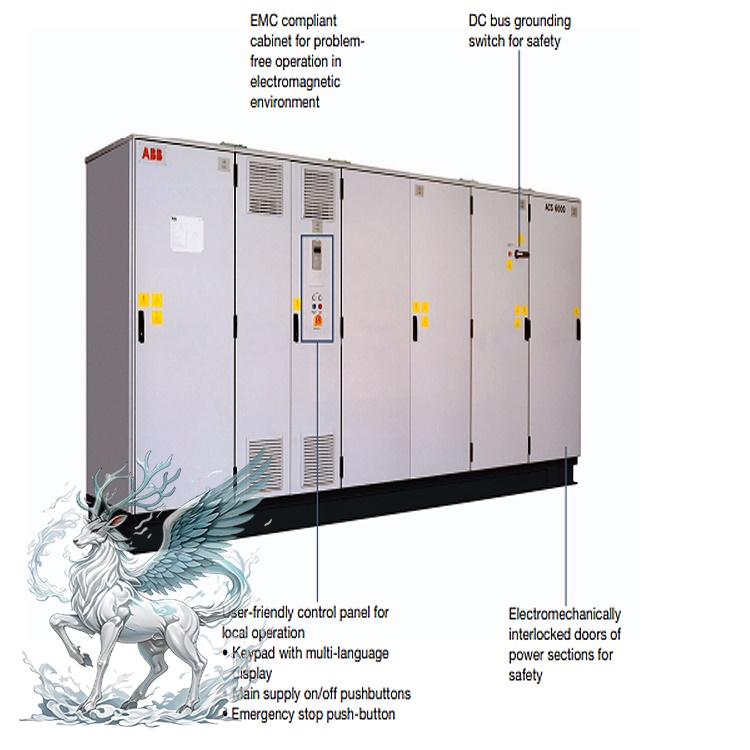
Positioning: Belongs to the phase module of the ACS6000 series medium-voltage
frequency converter (such as sub-models S-093N, S-093M, S-093H, etc.). It adopts
a three-level neutral point clamp (NPC) circuit design, supports
reverse-conducting IGCT power devices, and achieves high-efficiency energy
conversion and low harmonic output (THD<3%, compliant with IEEE 519
standard).
Technical
Architecture: Employs reverse-conducting IGCT (Integrated Gate Commutated
Thyristor) power devices to construct a three-level neutral point clamping (NPC)
circuit, supporting high-frequency switching (kHz level) for efficient
DC-AC/AC-DC conversion.
Voltage
and Power: Suitable for 6kV/10kV voltage levels, with rated power covering
megawatt levels (e.g., 9MV, 7MV scenarios), supporting direct grid connection or
connection via an input isolation transformer.
Key
Parameters:
Power
Range: Suitable for high-power scenarios of 4-120 MVA, with voltage levels
covering 3.3kV and below.
Electrical
Parameters:
Input
Voltage: 24V DC ±10% (standard), with optional 110-220V AC/DC wide voltage
version.
Power
Consumption: ≤15W (full load).
Output
Signals: Digital outputs (8-channel dry/wet contacts), analog outputs (4-channel
4-20mA or 0-10V DC), relay outputs (4-channel, 5A@250V AC/3A@30V DC).
.jpg)
Efficiency
and Harmonics: System efficiency ≥92%, Total Harmonic Distortion (THD) <3%
(compliant with IEEE 519 standard).
Environmental
Adaptability: Operating temperature -25℃ to +70℃, IP20 protection rating (higher
options available), suitable for harsh industrial environments such as humidity
and vibration.
Communication
Capabilities: Supports PROFIBUS DP, Modbus TCP/IP, Ethernet (OPC UA/IEC 61850
optional), compatible with Siemens, Omron, and other PLCs and ABB 800xA control
systems.
Precise
Phase Control: Synchronizes voltage/current phase to ensure stable system
operation under power grid fluctuations or load changes.
Four-Quadrant
Operation: Supports regenerative braking to improve energy efficiency (system
efficiency ≥92%).
Power
Quality Management: Enables reactive power compensation and fault ride-through
in STATCOM applications, conforming to the IEEE 519 harmonic standard (THD <
3%).
Protection
Functions: Overvoltage/undervoltage, overcurrent, short circuit, and
over-temperature protection; built-in fast fault isolation mechanism.
Interfaces
and Communication:
High
Voltage Input/Output: Hard copper busbars with insulated fasteners.
Fieldbus:
Supports PROFIBUS DP, Modbus TCP/IP, OPC UA, and IEC 61850.
Compatibility:
Seamless integration with ABB 800xA and AC 800M control systems and third-party
PLCs (such as Siemens and Omron).
Application
Scenarios:
Industrial
Drives: Energy-saving speed control for fans, pumps, and conveyors; precise
start/stop and speed regulation of production line motors.
New
Energy Fields: Wind power pitch control systems and yaw drive control; solar
tracking system motor drives; power quality optimization for energy storage
systems.
Rail
Transit: Dynamic speed control and regenerative braking for subway and light
rail vehicles.
Heavy
Industrial Environments: Suitable for demanding environments such as oil and
gas, mining, and metallurgy, featuring modular design and a dual-mode cooling
system (air-cooled/water-cooled).
Maintenance
and Operation Characteristics:
Modular
Design: Supports hot-swapping for quick replacement of faulty modules, reducing
downtime; flexible rack/rail mounting, compatible with 19-inch standard
racks.
Diagnostics
and Monitoring: Built-in LED status indicators (e.g., RUN/ERR), supports
self-diagnostic functions; parameter configuration, fault diagnosis, and status
monitoring via ABB Control Builder tool.
Cooling
System: Dual-mode closed-loop cooling design ensures stable operation in
high-temperature environments.
Lifespan
and Reliability: Mean Time Between Failures (MTBF) > 100,000 hours; utilizes
long-life capacitors and inductors, with a design life exceeding 15 years.
Physical
Characteristics and Compatibility
Mechanical
Design: Compact design (approx. 4×25.3×27.3cm), weight 1.72-1.75kg, supports
19-inch rack or DIN rail mounting, IP20 protection rating (higher protection
optional).
Maintenance
and Upgrades: Supports live replacement (hot-swappable), equipped with
self-diagnostic functions and LED status indicators, global spare parts supply
and technical update services provided.
Installation
of S-093N S-093N 3BHB009885R0021 Phase Module
Safety
and Preparation
Before
performing any operations on the phase module, completely disconnect, lock, tag,
and ground the ACS6000 driver.
Follow
the ABB manual to allow the DC link to discharge for the specified time, and
confirm the absence of voltage with appropriate instruments.
Close
the cooling water valve to release pressure and allow the module to cool; wear
appropriate personal protective equipment for medium-voltage work (arc
protector, insulating gloves, face mask, safety shoes).
Ensure
the work area is clean, dry, anti-static, and has sufficient space for lifting
equipment and module handling.
Tools
and Lifting Equipment
Slide
two support rails into the brackets below the phase module inside the
cabinet.
Safety
pins for securing the rails, a crane rated to the module's weight, a lifting
boom, and two M12 bolts for securing the lifting boom to the module.
.jpg)
Torque
wrench (maximum torque 83 Nm), hex socket for tightening bolts, and basic hand
tools for installing brackets and covers.
Removing
the Old Phase Module
Confirm
the drive is grounded and the cooling system is isolated.
Remove
all front covers to access the phase module in the ACS6000 cabinet.
Insert
the two rails under the module: slide them in until they engage with the rear
bracket, then lock them in place with the front safety pins.
Loosen
and remove the four main fastening bolts securing the phase module to the
cabinet (typically two upper bolts and two lower bolts).
Connect
the crane to the three lifting points on the cabinet, then attach the boom to
the module using two M12 bolts.
Slightly
lift to reduce weight, then carefully slide the module out along the guide
rails. If necessary, place it on a flat surface for further processing. 3.
Prepare the new S-093N 3BHB009885R0021
Before
installation, check for shipping damage, loose parts, or bent connectors.
Verify
that the part number and version (S-093N 3BHB009885R0021) match the original module and
ACS6000 configuration.
Keep
water pipe connections sealed/clean, and ensure all electrical connections are
intact and dry.
Install
the new phase module
Lubricate
the four fastening bolts with MOLYKOTE Type D grease as per ABB
specifications.
Attach
the boom to the new module using two M12 bolts and connect it to the crane.
Lift
the module, align it with the cabinet opening, and place it on the support
rails.
Slowly
push the phase module along the rails towards the rear wall until it stops in
the designated position.
Install
the fastening bolts, first the top pair, then the bottom pair, tightening them
evenly.
Use
a torque wrench to tighten all four fastening bolts to 83 Nm (the value given
for the phase module in the ACS6000 maintenance manual).
Remove
the crane, boom, and support rails (pull out the safety pins, then slide the
rails out).
Reconnect
the cooling water pipes according to the drive installation instructions, paying
attention to the correct inlet/outlet positions and minimum clearance from the
busbars. Completely reconnect all electrical connectors and grounding wires as
they were on the removed module.
Final
Inspection and Commissioning
Check
the cabinet for any remaining tools, bolts, or foreign objects, and ensure all
covers and doors have been reassembled.
Restore
the cooling water supply, check for leaks, and ensure flow and pressure are
normal before powering on.
Remove
the grounding wire and lock/tag as per the on-site procedures, then power on
according to the ACS6000 startup sequence and monitor for alarms or unusual
sounds.
If
any diode/IGCT work has been performed on the module, follow the specific clamp
gauge and reassembly steps in "Replacing Diodes and IGCTs in 7/9 MVA Phase
Modules" before installation.
In
summary, this module is a core component of ABB's high-voltage inverter system,
renowned for its high reliability, low harmonic output, and flexible integration
capabilities. It is suitable for precision power control needs in various fields
such as industry, energy, and transportation.


 ABB
ABB GE
GE HONEYWELL
 TRICONEX
 KONGSBERG
 EMERSON
 FOXBORO
 MOTOROLA
 VIBRO-METER
 ICS TRIPLEX
 WOODWARD
 BENTLY NEVADA
 OTHER
OTHER Home
Home.jpg)
.jpg)