All products on this website are
specialized items subject to fluctuating market prices.
Please refer to the customer service
quotation for the actual price, as the listed price is not
definitive.
Before placing an order, please confirm
details such as the model, product specifications, and pricing with customer
service.
Please contact customer service for
further information regarding these products.
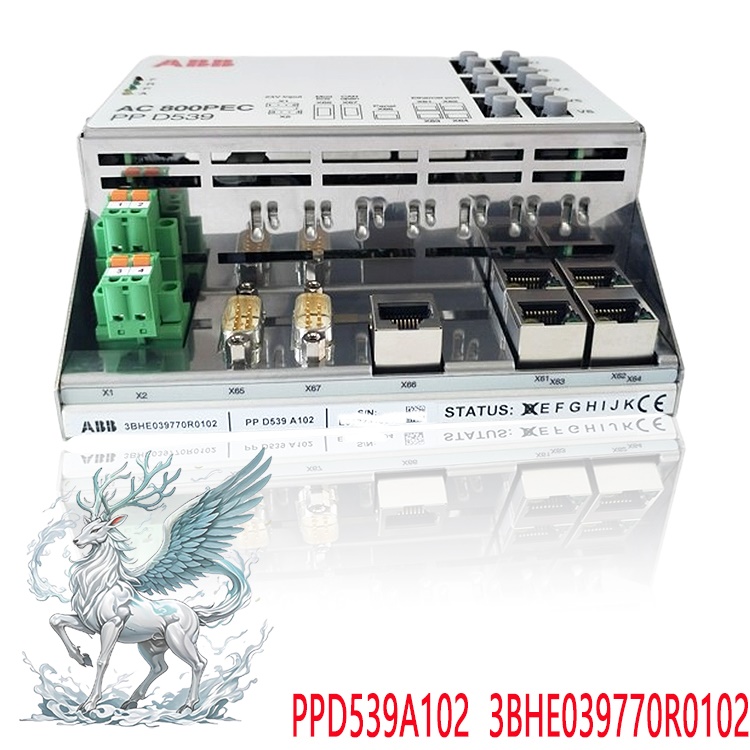
PPD539A102 3BHE039770R0102– Alternative Names:
High-performance excitation central
processing unit PPD539A102 3BHE039770R0102
PPD539A102 3BHE039770R0102
Excitation communication control unit
Programmable
control unit PPD539A102 3BHE039770R0102
I.
Operating Principle
The AC800PEC (PPD539A102 3BHE039770R0102)
is a high-performance, real-time controller with a heterogeneous architecture
designed by ABB for the power electronics
conversion sector. Its hardware utilizes a collaborative computing architecture
featuring a PowerPC main processor and an FPGA co-processor. It employs
a three-layer task scheduling mechanism that separates slow process management,
high-speed closed-loop control, and low-level high-speed I/O timing.
.jpg)
Layer
1 (Slow Task Layer): The main processor executes logic programs compliant with
the IEC 61131-3 standard. It handles non-critical real-time tasks such as system
monitoring, parameter management, human-machine interaction, communication with
the 800xA DCS platform, and event logging. Engineering configuration is
performed using Control Builder
M.
Layer
2 (High-Speed Control Layer): This layer runs core power electronics control
algorithms and supports deterministic control cycles as short as 100 μs. It
enables the automatic generation of control code based on MATLAB/Simulink models
to achieve rapid closed-loop regulation of voltage, current, and power, serving
as the core control kernel for converters and excitation systems. Layer 3
(FPGA-based high-speed I/O): The FPGA independently handles high-speed pulse
timing, optical signal transmission/reception, signal acquisition and
preprocessing, and rapid hardware-level fault protection. It operates without
consuming CPU computing
resources, enabling nanosecond-level switching pulse generation and transient
fault response. Fiber-optic links are used to isolate high-voltage electrical
interference and eliminate ground loop effects.
Workflow:
Analog signals from field sensors (such as voltage and current) are acquired via
high-speed I/O and sent to the controller, where the FPGA preprocesses the
signals and forwards them to the processor. Based on preset control models, the
processor calculates and outputs trigger commands; the FPGA then generates PWM
pulses to drive the power devices. Simultaneously, the system status is
continuously monitored; if faults such as overcurrent, overvoltage, or
undervoltage are detected, the hardware protection circuit can rapidly block
pulses to execute protective actions. The controller is integrated into the ABB
800xA automation system, enabling collaborative monitoring and scheduling of the
entire system with the upper-level DCS.
II.
Key Functions
High-speed
real-time closed-loop control: Designed specifically for
high-power power electronic
devices, it implements algorithms such as vector control, direct torque control,
excitation regulation, and grid-connected power control. It rapidly and stably
regulates output voltage, current, and active/reactive power, meeting the
millisecond- or even microsecond-level dynamic response requirements of
converters.
.jpg)
Built-in
power electronics protection: Integrates fault detection and protection logic
for conditions such as overcurrent, overvoltage, undervoltage, open circuits,
and overheating. It supports a dual-mechanism approach combining software
protection with rapid FPGA hardware protection, allowing for controlled
shutdowns during faults to avoid production shocks caused by abrupt hard trips.
It also features fault recording, fault diagnosis, and event alarming
capabilities to facilitate fault analysis.
Multi-type
communication interaction: Configured with high-speed fiber-optic PEC links and
Ethernet, it supports integration into the ABB 800xA system and
is compatible with various industrial communication protocols. Fiber-optic
communication offers strong electrical isolation, making it suitable for
high-voltage, high-power equipment environments and enabling synchronized,
collaborative control across multiple controllers. Flexible Engineering and
Model-Based Design: Supports dual development modes; standard logic utilizes IEC
61131-3 languages, while complex control algorithms can be developed via
Simulink modeling and automatic code generation, significantly shortening the
algorithm development and verification cycle. It also supports online
configuration and firmware upgrades.
System
Status Monitoring and O&M: Real-time acquisition of operating parameters
from both the controller and the controlled equipment enables status diagnostics
and the integration of predictive maintenance functions. Modules feature
built-in status indicators for convenient on-site commissioning and
troubleshooting. Redundancy configurations are supported, allowing seamless
switching between primary and backup controllers to enhance system operational
reliability.
Process
Logic Control: In addition to power electronics algorithms, the system possesses
standard PLC sequential control capabilities. It handles both power conversion
control and interlocking logic for auxiliary equipment, valves, and discrete
I/O, enabling a single controller to manage both power regulation and process
interlocking.
III.
Application Areas
This
controller (PPD539A102 3BHE039770R0102 ) is primarily designed as the master control unit
for high-power power electronic conversion devices, serving industrial and power
sector applications that demand extremely high dynamic response and
reliability:
Generator
Excitation Control Systems: A primary application; acting as the core controller
for generator excitation regulators, it adjusts excitation current in real-time
to stabilize terminal voltage and control reactive power, ensuring stable
grid-connected operation. It is widely used in thermal, hydroelectric, and
gas-fired generator units.
High-Power
Converter Drive Systems: Medium- and high-voltage, high-power variable frequency
drives—such as main drives for metallurgical rolling mills, large-scale mine
hoists, and heavy-duty cement industry drives—enabling high-precision torque and
speed control for motors.
.jpg)
Grid
Power Conversion and Energy Storage Systems: Applications include Static Var
Generators (SVG), active power filters, and grid-connected energy storage
converters, facilitating grid harmonic mitigation, reactive power compensation,
and power regulation for renewable energy grid integration. Metallurgical
Electrolysis Industry: Control of high-power rectifier power supplies for
aluminum electrolysis; provides stable DC output and features load fluctuation
detection and load regulation capabilities to ensure a steady DC power supply to
electrolytic cells.
Power
Electronics Test Platforms: High-power power conversion and power electronics
R&D test benches; leverages the advantages of Simulink model-based
development to rapidly validate various novel control algorithms.
Other
Heavy Industrial Power Supplies: Applications such as high-power DC power
supplies and specialized industrial power conversion units.
IV.
Brief Summary
The PPD539A102 3BHE039770R0102 AC800PEC controller utilizes a heterogeneous CPU+FPGA real-time
architecture, combining high-speed closed-loop control for power electronics
with standard industrial process logic. It offers rapid hardware protection
response and strong anti-interference capabilities. Compatible with ABB 800xA
systems, it serves primarily as the master control unit for excitation systems
and high-power converters, finding application in industrial sectors—such as
power generation, metallurgy, new energy, and heavy-duty drive systems—that
demand rigorous real-time performance and reliability.
Recommended
related products:
GFD212A
3BHE020357P201
3BHE020356R0101
GFD212
3BHE022294R0101
GFD233
3BHE022294R0103
GFD233
3BHE046836R0101
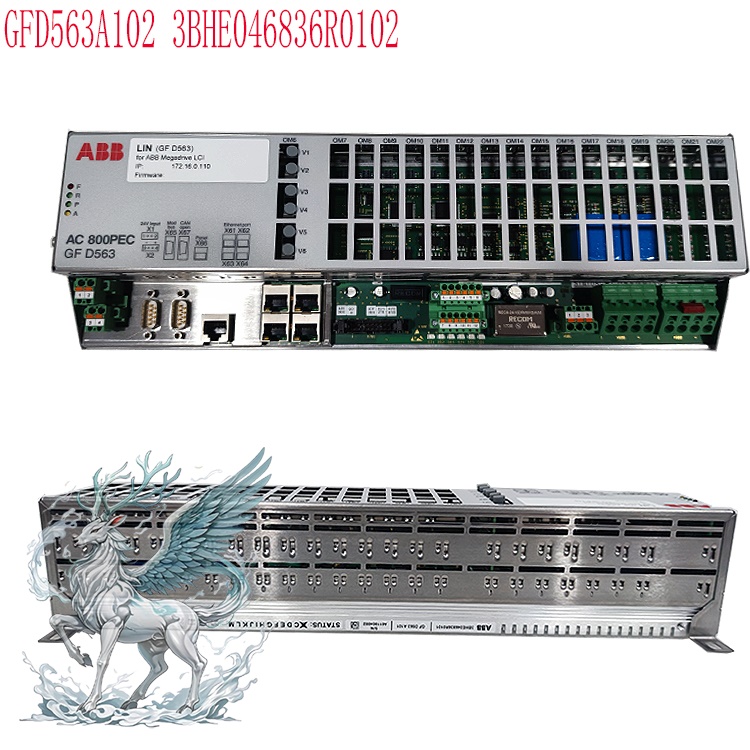
GFD563
3BHE046836R0102
GFD563A102
ABB
5SHY35L4503
3BHE031197R0001
GBU72
3BHE055094R0002
GBU72
L003748-AR
ABB-3BSX108237R300
ABB
5SDD1060F0001
ABB
5SDF1045H0002
ABB
5SGX1060H0003
ABB
5SGX10H6004
ABB
5SGY3545L0003
ABB
5SGY3545L0010
ABB
5SGY3545L0017
ABB
5SGY3545L0020
5SGY3545L0010
3BHB006485R0001
5SHY35L4503
3BHB004692R0002
More......
1.Do you offer global shipping?
Yes. We have local distribution centers on every continent, enabling us to quickly ship parts to anywhere in the world.
2. What payment methods and currencies do you accept?
To make your purchasing process as simple and convenient as possible, we offer a variety of payment methods, including bank transfer, cheque, and PayPal. We also accept most major credit and debit cards, such as Visa, Mastercard, and American Express. We accept payments in most major global currencies, but we recommend using US Dollars (USD), British Pounds (GBP), or Euros (EUR). Using other currencies may incur additional fees. All transactions are securely processed by HSBC and HSBC Merchant Services.
3.How much parts do you currently have in stock?
We have a vast inventory of new, refurbished, and used automation components, including products from well-known manufacturers such as ABB and Schneider Electric. If you can't find the part you need, don't worry. We work closely with professional suppliers worldwide, and even if the part you need isn't listed on our website, we can provide you with a tailored quote.
4.Who should I contact if I encounter any problems?
Our experienced customer service team will handle any issues after you place your order.


 ABB
ABB GE
GE HONEYWELL
 TRICONEX
 KONGSBERG
 EMERSON
 FOXBORO
 MOTOROLA
 VIBRO-METER
 ICS TRIPLEX
 WOODWARD
 BENTLY NEVADA
 OTHER
OTHER Home
Home
.jpg)
.jpg)
.jpg)


.jpg)