Note that all products on this website
are special items, and market prices are constantly
fluctuating.
Please refer to customer service for a
quote, as the price may not be accurate as the product is
new.
Please confirm the model, product,
price, and other detailed information with customer service before placing an
order. This website is currently in use.
New items are available for sale; please
contact customer service for further information.
3BHE046836R0102 GFD563A102 Other Names:
Excitation
Central Processing Unit 3BHE046836R0102 GFD563A102
3BHE046836R0102 GFD563A102
LCI Controller
Excitation
Hybrid Input/Output Device 3BHE046836R0102 GFD563A102
I.
Load-Commutated Inverter (LCI) Working Principle
LCI
is a current-source type high-power frequency converter. The main circuit
topology is: grid-side thyristor rectifier bridge → DC smoothing reactor →
motor-side thyristor inverter bridge, driving the electrically excited
synchronous motor.
.jpg)
Rectification
Stage: Three-phase AC power from the grid is fully rectified by thyristors into
DC current, which is maintained at a relatively constant level by a large DC
reactor.
Load
Commutation Core: Ordinary thyristors lack self-turn-off capability. The
thyristor turn-off is achieved using the back EMF of the synchronous motor
stator as the commutation voltage. By adjusting the synchronous motor
excitation, the stator current phase leads the back EMF, creating the conditions
for load commutation without the need for an additional forced commutation
circuit.
Inverter
Output: The inverter bridge thyristors are sequentially triggered according to
the rotor position signal, inverting the constant DC current into AC current
with a frequency that varies with the motor speed, supplying the synchronous
motor stator. Changing the trigger angle changes the output frequency, achieving
motor speed regulation.
Low-Speed
Auxiliary Commutation: When the motor speed is very low, the back EMF is
insufficient for load commutation. The system enters pulse commutation mode,
where the rectifier bridge briefly pulls the DC current to zero, turning off the
inverter thyristors. The system automatically switches back to load commutation
mode as the speed increases.
Dual
Closed-Loop Control: The inner current loop controls the rectifier side firing
angle to limit armature current; the outer speed loop provides the output
current, which, combined with rotor position, commutation lead angle, and
commutation residual angle compensation algorithms, ensures reliable commutation
and avoids commutation failure.
II.
Role and Application Areas of LCI Load Converter Inverter Units in
Industry
Core
Roles
Large
Synchronous Motor Soft Start: Limits starting current, avoiding direct starting
with 6-7 times the rated current impacting the grid; allows smooth acceleration
from zero to rated speed, with stable and controllable torque during
startup.
High-Power
Speed Regulation Drive: Enables speed regulation of MW-100 MW level synchronous
motors, supports four-quadrant operation, and can be electric or regenerative
braking.
Gas
Turbine/Steam Turbine Generator Turning Wheel Start: As a static variable
frequency drive (SFC) for large units, it uses the generator as a synchronous
motor to drive speed increase, completing unit startup without the need for an
expensive starter motor.
.jpg)
Synchronous
Condenser Start: Drives the synchronous condenser from zero speed increase and
then connects to the grid for reactive power compensation.
Typical
Application Areas
Petrochemical
Industry: Large compressors (ethylene three-unit), large blowers;
Power Industry:
Pumped storage unit static frequency converter (SFC) starter, synchronous
condenser starter;
Metallurgy:
Blast furnace blowers, large synchronous motor drives;
Oil
& Gas: Large turbine unit starter;
Industrial
large high-speed pumps, large fans.
Power
Coverage: 1MW~100MW, representing the power portion of ABB MEGADRIVE-LCI
products from ABB Group.
III.
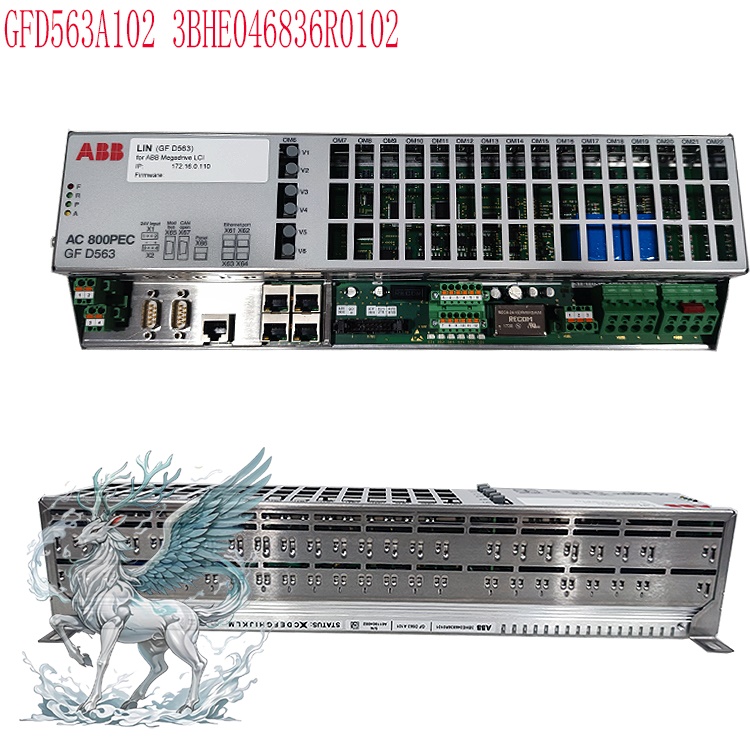
Application of 3BHE046836R0102 GFD563A102 in the AC800PEC Control System
The
AC800PEC is ABB's high-speed controller platform for power electronics,
featuring a CPU+FPGA heterogeneous architecture, supporting control cycles as
low as 100μs, nanosecond-level FPGA logic, and specifically designed for LCI,
excitation, high-voltage converters, and flexible DC control. The
3BHE046836R0102 GFD563A102 is the main control CPU module of the AC800PEC, responsible for
the following tasks in the entire LCI system:
Running
the complete LCI control algorithm
Speed
closed-loop and current closed-loop calculations; rotor position signal
acquisition, commutation lead angle calculation, and residual angle
compensation; rectifier bridge and inverter bridge trigger angle calculation;
low-speed pulse commutation logic.
The
algorithm is developed using Control Builder + Simulink modeling, and downloaded
and run in this module.
Signal
acquisition closed-loop: Acquires motor stator voltage, current, rotor position,
DC current, and system status; receives various fault signals from the power
cabinet (overcurrent, overheating, water-cooling fault, thyristor
monitoring).
Pulse
transmission link: Generates thyristor trigger timing, sends it via the AC800PEC
backplane PPA bus to the fiber optic interface board (such as UCD240), converts
it into optical pulses, and sends them to the thyristor trigger unit in the LCI
power cabinet; simultaneously receives status reports from the power valve
group.
Complete
protection logic: Implements protection against commutation failure,
overcurrent, overvoltage, DC overcurrent, loss of excitation, and overspeed.
Upon detecting an anomaly, it quickly modifies the trigger angle, returns the
phase to zero, and executes system shutdown interlocks.
Process
logic and external communication: Executes LCI start/stop timing and interlock
logic; provides Ethernet and Profibus interfaces for interaction with the
upper-level 800xA and DCS systems, uploading alarm and waveform data, and
supporting transient fault recording.
Hardware
redundancy capability: The rack supports dual 3BHE046836R0102 GFD563A102 redundancy
configurations, enabling seamless primary-backup switching to meet the
high-availability LCI system requirements of petrochemical and power plant
applications.
System
Hierarchy
LCI
Power Unit (Thyristor Rectifier / Reactor / Inverter Power Valve) ↔ Fiber Optic
Interface Board UC-D240 ↔ AC800PEC Backplane PPA Bus ↔ 3BHE046836R0102 GFD563A102 Main
Control Module ↔
DCS/800xA Host System.
IV.
Common Fault Concerns (Key Maintenance Points for This
Architecture)
LCI
Body: Insufficient commutation residual angle causing commutation failure;
abnormal pulse commutation in low-speed range; thyristor damage; insulation and
temperature rise of smoothing reactor.
3BHE046836R0102 GFD563A102
Side: Abnormal rotor position signal sampling; FPGA pulse timing jitter; PPA
backplane link failure; unstable 24VDC power supply to the module; firmware
version mismatch causing LCI algorithm abnormalities.
Fiber
optic link: triggering fiber aging and insufficient optical power, resulting in
thyristor trigger loss.
Recommended
related products:
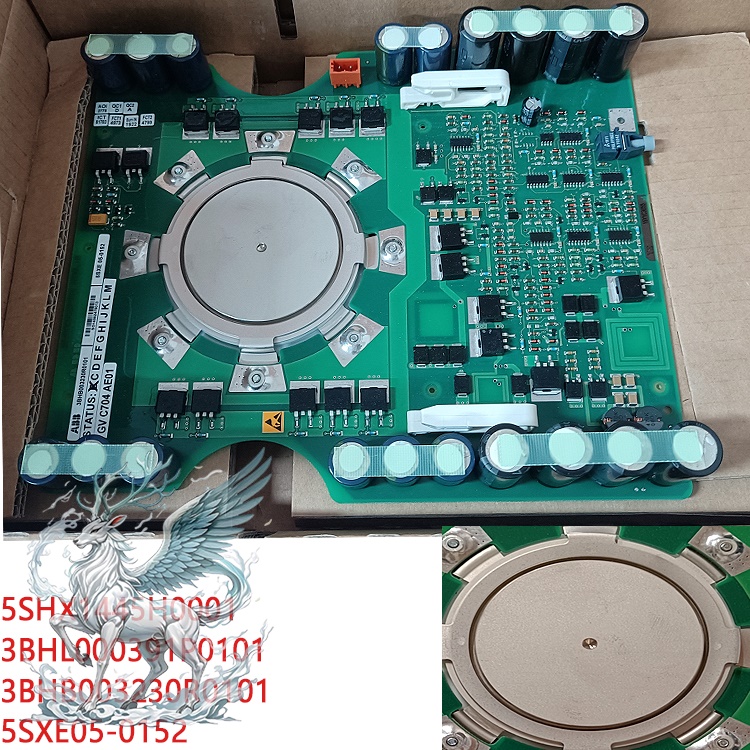
ABB
5SHY35L4503
3BHE031197R0001
GBU72
3BHE055094R0002
GBU72
L003748-AR
ABB-3BSX108237R300
ABB
5SDD1060F0001
ABB
5SDF1045H0002
ABB
5SGX1060H0003
ABB
5SGX10H6004
ABB
5SGY3545L0003
ABB
5SGY3545L0010
ABB
5SGY3545L0017
ABB
5SGY3545L0020
5SGY3545L0010
3BHB006485R0001
5SHY35L4503
3BHB004692R0002
More......
1.Do you offer global shipping?
Yes. We have local distribution centers on every continent, enabling us to quickly ship parts to anywhere in the world.
2. What payment methods and currencies do you accept?
To make your purchasing process as simple and convenient as possible, we offer a variety of payment methods, including bank transfer, cheque, and PayPal. We also accept most major credit and debit cards, such as Visa, Mastercard, and American Express. We accept payments in most major global currencies, but we recommend using US Dollars (USD), British Pounds (GBP), or Euros (EUR). Using other currencies may incur additional fees. All transactions are securely processed by HSBC and HSBC Merchant Services.
3.How much parts do you currently have in stock?
We have a vast inventory of new, refurbished, and used automation components, including products from well-known manufacturers such as ABB and Schneider Electric. If you can't find the part you need, don't worry. We work closely with professional suppliers worldwide, and even if the part you need isn't listed on our website, we can provide you with a tailored quote.
4.Who should I contact if I encounter any problems?
Our experienced customer service team will handle any issues after you place your order.


 ABB
ABB GE
GE HONEYWELL
 TRICONEX
 KONGSBERG
 EMERSON
 FOXBORO
 MOTOROLA
 VIBRO-METER
 ICS TRIPLEX
 WOODWARD
 BENTLY NEVADA
 OTHER
OTHER Home
Home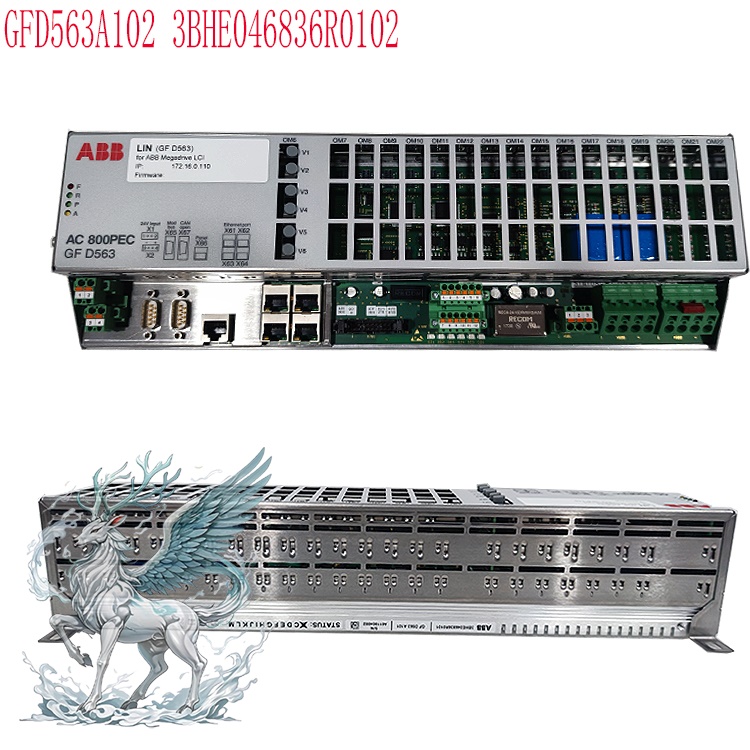
.jpg)
.jpg)


.jpg)