Note that all products on this website
are special products, and market prices are constantly
fluctuating.
Please refer to customer service for a
quote, as the price may not be accurate as the product is
new.
Please confirm the model, product,
price, and other details with customer service before placing an order. This
website is currently in use.
New products are available for sale;
please contact customer service for further information.
5SGY3545L0010 Other Names:
IGCT Module
5SGY3545L0010
5SGY3545L0010
High Voltage Inverter Module
Semiconductor
Thyristor 5SGY3545L0010
The
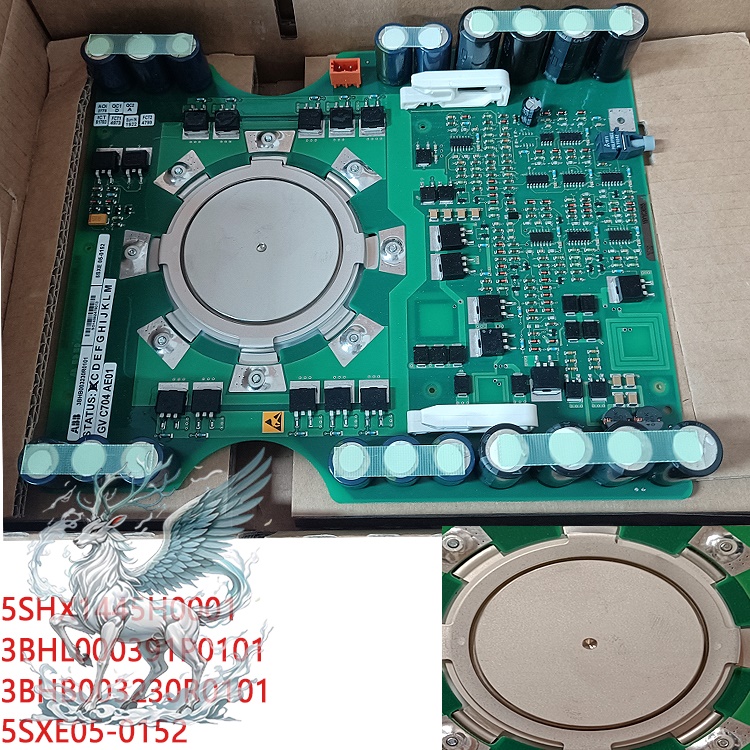
5SGY3545L0010 is an asymmetric gate turn-off thyristor (GTO) manufactured by ABB
Switzerland Ltd. Semiconductors. It has a voltage rating of 4500V and a maximum
interrupt current of approximately 4000A, making it a typical high-voltage,
high-current power switching device. A low-power gate control signal is used to
turn a high-power main circuit on and off, achieving high-power energy
conversion between DC and AC. Its most fundamental difference from a
conventional thyristor (SCR) is that a conventional thyristor can only be turned
on by gate triggering; once turned on, the gate loses control and must wait for
the main current to cross zero to turn off naturally. A GTO, however, can
actively turn off by applying a negative current pulse to the gate while it is
on. Therefore, in inverter circuits powered by the DC bus, there is no need for
a large forced commutation circuit for turn-off, which is the core reason why it
was widely used in locomotive traction and high-power frequency
converters in the past.
II.
Working Principle
1.
Internal Structure
A
GTO is a PNPN four-layer three-terminal semiconductor device:
The
outermost layers are a P+ anode and an N+ cathode;
The
middle layers are the N- base region and the P base region;
The
four semiconductor layers form three PN junctions: J1 (anode side), J2 (middle),
and J3 (cathode side);
The
gate is connected to the P base region, and the gate and cathode are formed with
a dense, interlaced finger-like structure—this is the key process that
distinguishes a GTO from a conventional thyristor, aiming to ensure that the
anode current is uniformly and quickly drawn into the gate circuit during
turn-off, preventing localized overheating and burnout.
2.
Conduction Principle (based on "injection")
When
a positive current pulse is applied to the gate, gate current is injected into
the P-base region;
A
large number of charge carriers cause avalanche breakdown in the J2 junction,
and the PNPN four-layer structure establishes regenerative positive feedback
(the two internal "equivalent transistors" amplify each other);
.jpg)
The
device quickly enters the conduction state, with a large current of several
thousand amperes flowing through the anode, while the on-state voltage drop is
only about 1~2V;
Once
conduction occurs, it is self-sustaining due to the large anode current, and the
gate only needs to provide a sustaining current (usually automatically adjusted
by the drive unit according to temperature) to maintain conduction.
3.
Turn-off Principle (Relying on "Draining," a unique capability of GTOs)
Apply
a negative current pulse to the gate;
The
negative gate current draws a large number of holes from the P-base region,
reverse-biasing the J3 junction (gate-cathode junction), and stopping the
cathode from injecting electrons into the device;
The
regenerative positive feedback within the four-layer structure is disrupted,
forcing the anode current to "intercept" and transfer to the gate circuit;
The
device completes turn-off, and thereafter, a continuous negative bias voltage is
applied by the gate drive unit to maintain the device in a stable blocking
state.
4.
Summary of Operating Characteristics
.jpg)
Asymmetric
Design: This device only withstands blocking voltage in the forward direction,
with very weak reverse blocking capability (typically only able to withstand
tens of volts). Therefore, a freewheeling diode must be connected in
anti-parallel in the circuit, hence the name "Asymmetric GTO."
Suitable
for medium-frequency switching applications (switching frequencies are typically
in the hundreds of Hz range), not suitable for ultra-high frequencies.
Both
turn-on and turn-off have their own switching losses, requiring the design of
snubber circuits to control di/dt and dv/dt.
III.
Application Areas
This
4500V/multi-kiloampere GTO is designed for high-voltage, high-current,
medium-frequency, high-power converter applications. Main applications
include:
Rail
Transit Traction Converter (Most Typical): Used in locomotives, EMUs, subways,
and light rails as traction inverters, converting DC power from the overhead
contact line or third rail into three-phase AC power to drive the traction
motor, while simultaneously achieving regenerative braking energy feedback. ABB
developed modular high-power converters centered on GTOs for mainline traction
locomotives, employing oil-immersed cooling.
Medium-voltage
high-power variable frequency drives (MV Drives) are used in mine hoists,
rolling mill main drives, large fans/pumps/compressors, and marine electric
propulsion, providing precise speed control for high-voltage, high-power AC
motors.
High-power
static frequency converters (SFCs) are used, for example, in pumped storage
power station unit starting devices and high-power AC-AC converters; ABB once
used GTOs in series and parallel to construct a 100MVA-class static frequency
converter.
High-power
power supply equipment is used in applications requiring high current
conversion, such as induction heating power supplies and
electrolysis/electroplating rectifier power supplies.
Power
system compensation and transmission include static var compensators
(SVCs/STATCOMs) and early HVDC converter stations.
Macroscopic
function summary: It is a high-efficiency, high-power switch connecting the "DC
high-voltage bus" and the "AC load," determining the capacity limit and
efficiency of high-power power conversion systems. It was a core component of
high-power power electronic devices from the 1980s to the 2000s.
IV.
Usage Environment and Supporting Requirements
Required
Driver: ABB GTO gate unit (e.g., GV A587 series) is required. This driver
provides the turn-on pulse, temperature-regulated gate current, turn-off pulse,
and negative bias voltage after turn-off. Control commands and status feedback
are transmitted via fiber optic cable.
Cooling
Method: Press-pack packaging with double-sided cooling. A suitable heatsink
(air-cooled or water-cooled) is required to ensure the junction temperature
remains within acceptable limits. The junction temperature range for similar ABB
4.5kV high-voltage devices is approximately -40~125℃.
.jpg)
Installation
Method: Press-pack mounting with the specified pressure is required to ensure
good contact resistance and heat dissipation.
Electrical
Environment: Asymmetric devices only block in the forward direction; an
anti-parallel freewheeling diode is required. For 4.5kV devices in open air or
at sea level, a DC bus voltage of approximately 2800V is recommended (excluding
100 FIT from cosmic rays). Failure rate limits (reference values for family
specifications)
Environmental
conditions: Installed in an industrial converter cabinet, typically requiring an
ambient temperature range of approximately -40 to +50°C, with proper
moisture-proof, dust-proof, and corrosion-proof treatment.
Protection
requirements: High requirements are placed on heat dissipation design,
di/dt/dv/dt limits, and overcurrent protection (fast fuse/gate protection). The
absorption circuit must be designed according to the datasheet application
guide.
Recommended
related products:
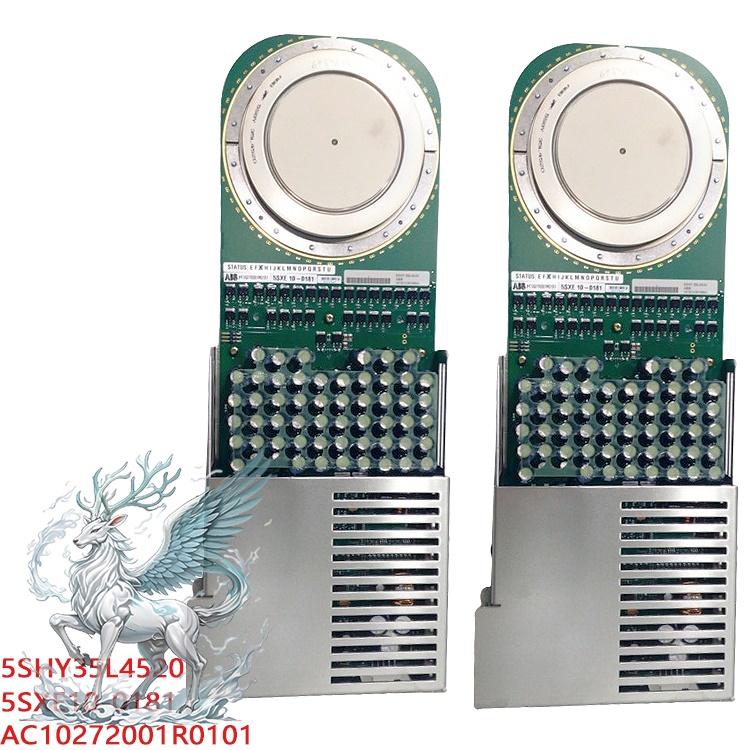
5SHY35L4503
3BHB004692R0002
5SHY35L4520
AC10272001R0101
5SHX0660F0001
3BHB003387R0101
5SHX06F6004
3BHB003387R0101
GDB021BE01
HIEE300766R0001
5SHY35L4510
3BHE014105R0001
5SHX08F4502
3BHB003387R0101
5SHX08F4502
3BHB003387R0101
3BHE024415R0101
5SHX1060H0003
5SHX2645L0002
3BHE009681R0101
5SHY4045L0006
3BHE039203R0101
5SHY4045L0006
3BHE039203R0101
3BHB009885R0063
S-093M
3BHB009885R0005
S-093H
3BHB009885R5311
S-093R
3BHB012897R0003
S-053M
3BHB009885R0004
S-093H
3BHB009884R0021
S-073N
3BHB018008R0003
S-113H
S-093N
3BHB009885R0001
S-093N
3BHB009885R0021
3BHT300026R1
DI651
More......
1.Do you offer global shipping?
Yes. We have local distribution centers on every continent, enabling us to quickly ship parts to anywhere in the world.
2. What payment methods and currencies do you accept?
To make your purchasing process as simple and convenient as possible, we offer a variety of payment methods, including bank transfer, cheque, and PayPal. We also accept most major credit and debit cards, such as Visa, Mastercard, and American Express. We accept payments in most major global currencies, but we recommend using US Dollars (USD), British Pounds (GBP), or Euros (EUR). Using other currencies may incur additional fees. All transactions are securely processed by HSBC and HSBC Merchant Services.
3.How much parts do you currently have in stock?
We have a vast inventory of new, refurbished, and used automation components, including products from well-known manufacturers such as ABB and Schneider Electric. If you can't find the part you need, don't worry. We work closely with professional suppliers worldwide, and even if the part you need isn't listed on our website, we can provide you with a tailored quote.
4.Who should I contact if I encounter any problems?
Our experienced customer service team will handle any issues after you place your order.


 ABB
ABB GE
GE HONEYWELL
 TRICONEX
 KONGSBERG
 EMERSON
 FOXBORO
 MOTOROLA
 VIBRO-METER
 ICS TRIPLEX
 WOODWARD
 BENTLY NEVADA
 OTHER
OTHER Home
Home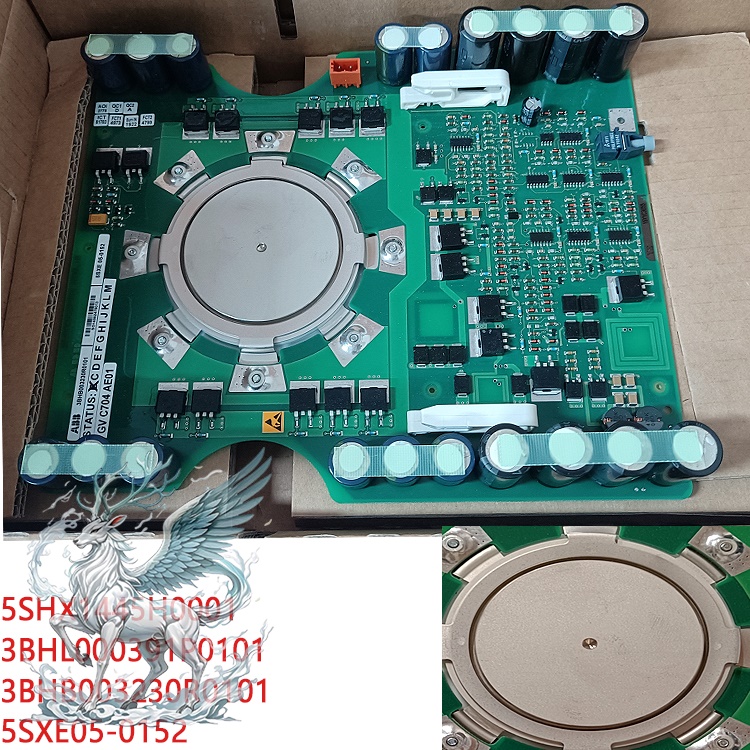
.jpg)
.jpg)
.jpg)


.jpg)
.jpg)