Many products are not yet listed. Please
contact us for more product information.
If the product model differs from the
displayed image, the model number shall prevail. Please contact us for specific
product images; we will arrange to take photos in our warehouse for
confirmation.
We have 76 shared warehouses worldwide,
so it may sometimes take several hours to accurately return the information to
you. We apologize for any inconvenience. Of course, we will respond to your
inquiries as soon as possible.
Other names for
DPS i1:
DGPS
sensor DPS i1
DPS i1
DGLONASS sensor
Positioning system host
DPS i1
The
DPS i1 is a high-performance, cost-effective DGNSS (Differential Global
Navigation Satellite System) sensor from the Norwegian company KONGSBERG,
belonging to their mature DPS product series. This device is designed
specifically for marine and near-shore applications, emphasizing high
availability, reliability, and decimeter-level positioning accuracy, suitable
for ship navigation, offshore platforms, and mission-critical scenarios.
Technical
Specifications and Performance
Decimeter-Level
Accuracy: Achieves 10cm (95% CEP) accuracy globally via Fugro Seastar G2
service, supporting GPS L1/L2, GLONASS L1/L2, and SBAS (such as WAAS, EGNOS)
signals.
Global
Coverage: Seastar SGG service provides orbit and clock bias correction,
achieving sub-meter-level global positioning regardless of reference station
distance.
Positioning
Accuracy: <0.5 meters (standard configuration), achieving decimeter-level
accuracy via Seastar G2 service, with high global consistency and unrestricted
by reference station distance.
.jpg)
Satellite
Systems: Supports GPS and GLONASS dual systems, expanding satellite coverage,
improving signal availability and anti-interference capabilities, especially
performing excellently in signal-obstructed environments (such as densely
populated island areas, mountainous coastal areas).
Interfaces
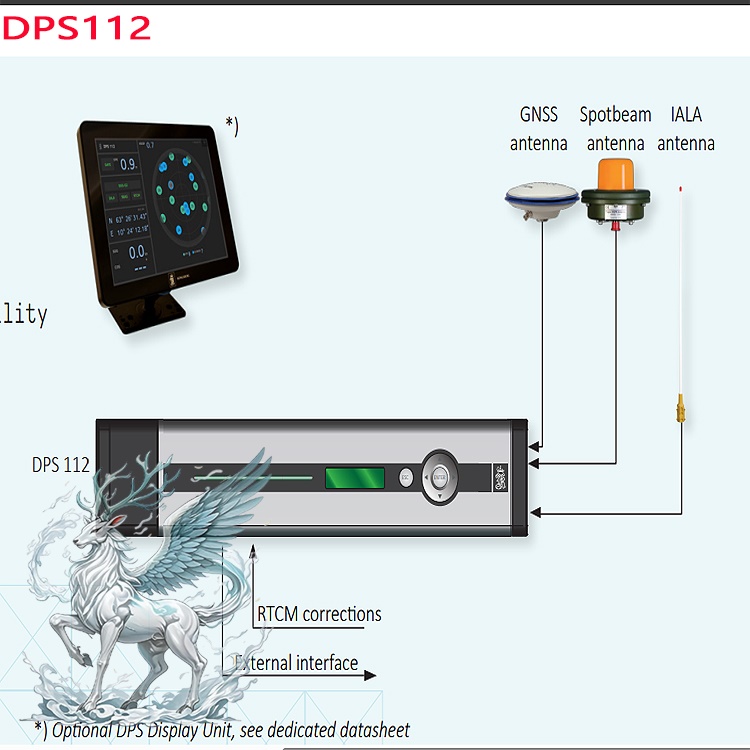
and Communication: Ethernet, USB, NMEA 0183/2000, PROFIBUS, Modbus; supports
RTCM standard input; configurable external interface output; compatible with
various control systems.
Multi-interface
design: 3 serial ports (2 NMEA outputs, 1 RTCM input, supporting RS-232/RS-422
electrical isolation), Ethernet/LAN, USB (for software updates).
Data
format: Compatible with NMEA 0183 v3.0 (GGA, GLL, GSA messages, etc.) and SNMP
v2.0 alarm protocol.
Optional
accessories: External display unit (supports customized graphical interface for
DP operation), IALA beacon receiver.
Environmental
adaptability: Operating temperature range -15°C to +55°C (device body), GNSS
antenna withstands -40°C to +85°C, meets IP30 protection rating, suitable for
harsh marine environments.
Redundancy
design: Supports dual (DP Class 2) or triple redundancy (DP Class 3)
architecture to ensure seamless switching in case of critical component failure
and maintain continuous positioning capability.
Power supply:
110-240 V AC, 50-60 Hz, compatible with marine power systems.
Features
Calibration
Service: Built-in L-band receiver, integrated Fugro Seastar SGG/G2 service,
utilizes a dual-system reference station network to calculate "orbit and clock"
calibration, providing globally consistent sub-meter/decimeter accuracy.
User
Interface: Embedded keyboard and display, optional external display unit,
supports a customized graphical interface for DP operation, intuitively
displaying position, heading, sensor data, and diagnostic information.
Maintenance
and Updates: Easy software updates via USB, supports regular sensor calibration
(recommended annually) and performance checks, ensuring long-term
reliability.
Compatibility:
Compatible with Kongsberg K-Pos dynamic positioning systems (such as DP-21,
DP-31), and can work in conjunction with the C-Joy joystick control system and
K-Thrust thruster control system.
KONGSBERG
DGNSS Sensor Core Models and Technical Parameters
DPS
Series:
DPS i1:
An economical DGNSS sensor supporting GPS L1/L2, GLONASS L1/L2, and SBAS (such
as WAAS, EGNOS). Achieves decimeter-level accuracy (10cm CEP) globally via Fugro
Seastar G2 service. Features 3 serial ports, Ethernet/LAN, and USB interfaces,
compatible with NMEA 0183 v3.0 and SNMP v2.0 protocols. Main unit dimensions:
89mm × 444mm × 357mm, weight: 5.8kg, operating temperature: -15°C to +55°C, IP67
protection rating.
.jpg)
DPS132/232/700/4D:
High-end models replacing the DPS i1, integrating IMU, expanding DP
functionality, supporting higher accuracy (such as sub-millimeter level) and
multi-satellite system fusion, suitable for complex marine environments and
critical mission scenarios.
GT
Series:
GT300/GT402/GT403:
Supports DC 10V-15V power supply, power consumption 0.25W, static accuracy
horizontal ±(2.5mm+1ppm), vertical ±(5mm+1ppm). Employs choke coil antennas and
magnetic absorbing materials to reduce multipath effects. Supports Modbus-RTU
protocol and RTCM3 differential data. Operating environment -40°C to +85°C.
Dimensions: Diameter 360mm × Height 163mm.
Application
Scenarios
Ships
Navigation: High-precision navigation for merchant ships, cargo ships, fishing
vessels, and yachts in complex waters (such as straits, ports, and coastal
waters) to ensure navigational safety.
Offshore
Operations: Precise positioning of oil drilling platforms, FPSOs (Floating
Production Storage and Offloading) vessels, and exploration vessels; precision
operations for underwater pipeline laying, submarine cable repair, and marine
geological exploration.
Specialty
Vessels: Precise maneuvering of research vessels, icebreakers, rescue vessels,
and ferries in narrow waterways or specific sea areas. Marine Engineering:
Offshore wind farm construction, tidal energy facility maintenance, and support
for wind turbine component installation and cable laying.
Special
Environments: Areas with severe signal obstruction, such as densely populated
island areas and mountainous coastal regions, utilize a multi-satellite system
(GPS+GLONASS) to enhance signal coverage and anti-interference capabilities.
Comparison
and Advantages
Comparison
with Traditional DGPS: Adding GLONASS expands satellite coverage and improves
system availability, especially in challenging signal environments (such as high
obstruction and multipath interference).
Superior
to Regional SBAS: Seastar SGG/G2 service, based on the Fugro dual-system
network, provides globally consistent accuracy, superior to regional SBAS
services such as WAAS and EGNOS, and IALA DGPS local service.
Safety
Certifications: Certified by DNV, Lloyd’s Register, ABS, and IMO DP Class 2/3,
meeting offshore operation safety standards and suitable for mission-critical
scenarios.
Installation
and Maintenance
Installation
Requirements: An assessment of the ship's structure and electrical system is
necessary to ensure that sensor installation locations (GPS antenna, beacon,
gyrocompass, etc.) avoid signal obstruction and interference; power supply and
communication cabling must comply with maritime safety standards.
Maintenance
Recommendations: Regularly calibrate sensors and check the condition of antennas
and connectors to ensure long-term stable system operation; software updates are
performed via USB interface, making operation simple.
The
DPS i1, with its high precision, high reliability, and flexible configuration,
has become an ideal positioning solution for professional vessels, offshore
platforms, and marine engineering, especially excelling in scenarios requiring
high safety and continuous positioning capabilities.


 ABB
ABB GE
GE HONEYWELL
 TRICONEX
 KONGSBERG
 EMERSON
 FOXBORO
 MOTOROLA
 VIBRO-METER
 ICS TRIPLEX
 WOODWARD
 BENTLY NEVADA
 OTHER
OTHER Home
Home.jpg)

.jpg)




.jpg)