Many products are not yet listed online; please contact us for more
information.
If the product model differs from the displayed image, the model number
takes precedence. Please contact us for specific product photos; we can arrange
for warehouse staff to take and verify images.
We operate 76 shared warehouses globally, so it may sometimes take a few
hours to provide an accurate response; we appreciate your understanding. Rest
assured, we will address your inquiries as quickly as possible.
I. Operating Principle
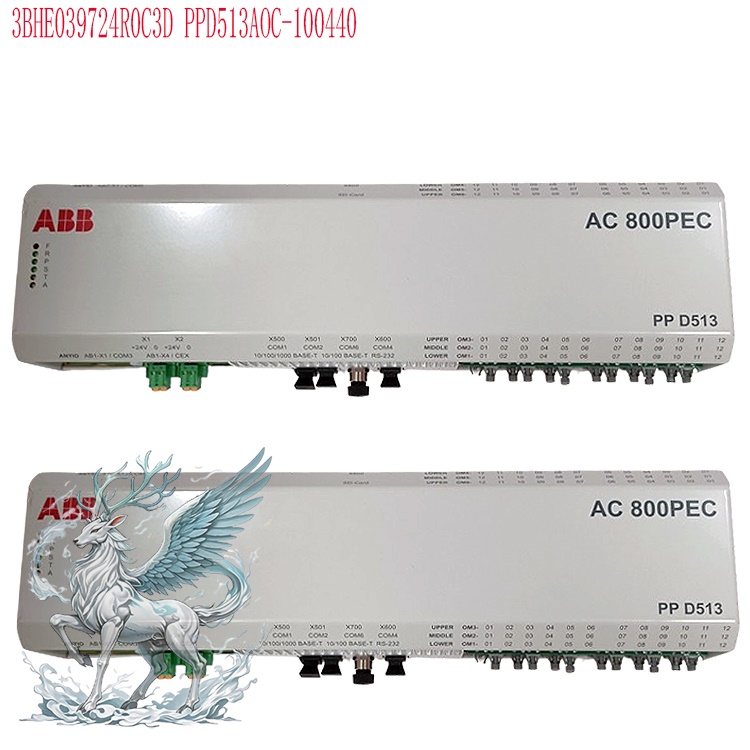
The AC800PEC platform utilizes a heterogeneous CPU+FPGA architecture,
integrating microsecond-level high-speed closed-loop control for power electronics and millisecond-level conventional process logic into a single
controller. This eliminates the need for separate high-speed controllers and
independent PLCs.
Signal Acquisition: Real-time acquisition of analog signals—such as
generator terminal voltage, stator current, rotor excitation current, unit
speed, and grid voltage—alongside digital signals (switch inputs) such as
circuit breaker status, cooling system status, and fault contacts.
AVR Closed-Loop Regulation Algorithm: Compares the measured terminal
voltage with the voltage setpoint and calculates the control output using PID
and Power System Stabilizer (PSS) algorithms. It automatically switches between
Automatic Voltage Regulation (AVR) mode, Manual Excitation Current Regulation
(FCR) mode, and Reactive Power Regulation mode.
Pulse Generation and Power Drive: The FPGA handles high-speed pulse logic,
transmitting trigger pulses via fiber optics to the thyristor rectifier bridge.
By adjusting the rectifier bridge's firing angle, it regulates the DC excitation
current supplied to the generator rotor. The typical fast control cycle is
approximately 400 μs, with pulse logic operating at the nanosecond level,
ensuring dynamic response speeds that meet grid disturbance requirements.
Limiting and Protection Logic: Includes built-in functions such as ceiling
excitation limiting, minimum excitation limiting, rotor overcurrent protection,
stator overcurrent protection, V/F limiting, loss-of-excitation protection, and
rotor overvoltage protection. If parameters exceed limits, excitation output is
prioritized for limitation; in the event of a severe fault, field suppression
(de-excitation) is executed. Redundant Architecture (Optional): Supports
dual-channel or triple-channel hot-standby redundancy, enabling bumpless
switching upon single-channel failure to meet high-availability requirements for
power plants; also supports communication with the 800xA DCS system to upload
event waveform records and operational data.
Nature of Static Excitation: The excitation power source is derived from
the generator terminal AC voltage; it is rectified by thyristors and supplied to
the rotor. There is no rotating exciter, and all control functions are performed
by the AC800PEC.
II. Core Functions
Automatic Voltage Regulation (AVR): Maintains generator terminal voltage at
the setpoint; rapidly adjusts excitation during grid voltage dips or load
fluctuations to ensure voltage quality.
Reactive Power Regulation: Switchable between constant reactive power and
constant power factor modes; controls the generator to supply or absorb reactive
power from the grid, participating in grid voltage support.
Power System Stabilizer (PSS): Suppresses low-frequency oscillations and
enhances grid transient stability; a mandatory function for grid
interconnection.
Multi-dimensional Limiting and Protection: Constrains operational
boundaries—such as excitation current, stator voltage, and magnetic
flux—throughout operation to prevent equipment damage caused by rotor
overheating, loss of excitation, over-excitation, or under-excitation.
.jpg)
Unit Synchronization Assistance and De-excitation Control: Coordinates with
the SYNCHROTACT synchronization device to complete grid connection; triggers the
de-excitation circuit during faults to rapidly dissipate rotor magnetic field
energy.
Data Waveform Recording, Event Logging, and Local/Remote Monitoring:
Features built-in fault waveform recording for post-incident analysis; supports
the ECT excitation commissioning terminal for parameter setting and simulation
testing.
System Interlock Logic: Manages auxiliary interlocks such as excitation
cabinet cooling, disconnect switches, and trip circuits. III. Application
Areas
Thermal and Gas Combined-Cycle Power Plants: Steam turbine generators and
gas turbine generators represent the primary application scenarios for the
UNITROL 6000; large-capacity units and grid-hub power plants typically utilize
dual-channel redundant configurations.
Hydropower Plants: Synchronous hydro-generators (including conventional
hydro and pumped-storage units); requires high performance regarding transient
response and stability.
Industrial Captive Power Plants: Synchronous generator units owned by
enterprises in sectors such as steel, chemicals, and papermaking.
Diesel/Gas Internal Combustion Synchronous Generators: Large-scale internal
combustion generator units.
.jpg)
Synchronous Condensers: Grid-side reactive power compensation units;
perform reactive power regulation only, without active power generation.
Marine Shore Power and Offshore Platform Generators: High-power marine
synchronous generators (utilizing static excitation schemes).
Large Synchronous Motor Drives: Excitation control (start-up and
steady-state regulation) for synchronous motors driving equipment such as mining
ball mills and large compressors.
IV. Summary of Key Advantages
A single controller handles both high-speed power electronics control and
conventional interlocking protection, reducing hardware count and potential
points of failure associated with communication conversion.
Wide-temperature-range hardware with robust EMC (electromagnetic
compatibility) performance, suitable for the high-interference environments
found in power plants.
Modular design supporting hardware redundancy; enables parameter
pre-commissioning via HIL (Hardware-in-the-Loop) simulation, thereby shortening
the on-site commissioning cycle.
Native integration with the ABB 800xA system, while also supporting
connectivity to third-party DCS or protection devices via Ethernet or fiber
optics.
Related product recommendations:
3BHE039724R0C4A-PP D513A0C
PPD513 A0E-110110 3BHE039724R0E41
3BHE039724R0E41 PPD513
3BHE039724R0C3D-800 PPD513
3BHE039724R0C3D PPD513
3BHE041576R3011 PPD517A3011
3BHE051476R3011 PPD517
3BHE041576R3011 PPD517
3BHE041576R3011 PPD517
PPD539A 3BHE039770R0102
PPD539A102 3BHE039770R0102
GFD212A 3BHE020357P201
3BHE020356R0101 GFD212
3BHE022294R0101 GFD233
3BHE022294R0103 GFD233
3BHE046836R0101 GFD563
3BHE046836R0102 GFD563A102
ABB 5SHY35L4503
3BHE031197R0001 GBU72
3BHE055094R0002 GBU72
L003748-AR ABB-3BSX108237R300
5SGY3545L0010 3BHB006485R0001
5SHY35L4503 3BHB004692R0002
More......
1.Do you offer global shipping?
Yes. We have local distribution centers on every continent, enabling us to quickly ship parts to anywhere in the world.
2. What payment methods and currencies do you accept?
To make your purchasing process as simple and convenient as possible, we offer a variety of payment methods, including bank transfer, cheque, and PayPal. We also accept most major credit and debit cards, such as Visa, Mastercard, and American Express. We accept payments in most major global currencies, but we recommend using US Dollars (USD), British Pounds (GBP), or Euros (EUR). Using other currencies may incur additional fees. All transactions are securely processed by HSBC and HSBC Merchant Services.
3.How much parts do you currently have in stock?
We have a vast inventory of new, refurbished, and used automation components, including products from well-known manufacturers such as ABB and Schneider Electric. If you can't find the part you need, don't worry. We work closely with professional suppliers worldwide, and even if the part you need isn't listed on our website, we can provide you with a tailored quote.
4.Who should I contact if I encounter any problems?
Our experienced customer service team will handle any issues after you place your order.


 ABB
ABB GE
GE HONEYWELL
 TRICONEX
 KONGSBERG
 EMERSON
 FOXBORO
 MOTOROLA
 VIBRO-METER
 ICS TRIPLEX
 WOODWARD
 BENTLY NEVADA
 OTHER
OTHER Home
Home
.jpg)
.jpg)