Many products have not yet been listed
online; please contact us for more information.
If the product model differs from the
displayed image, the model number takes precedence. Please contact us for
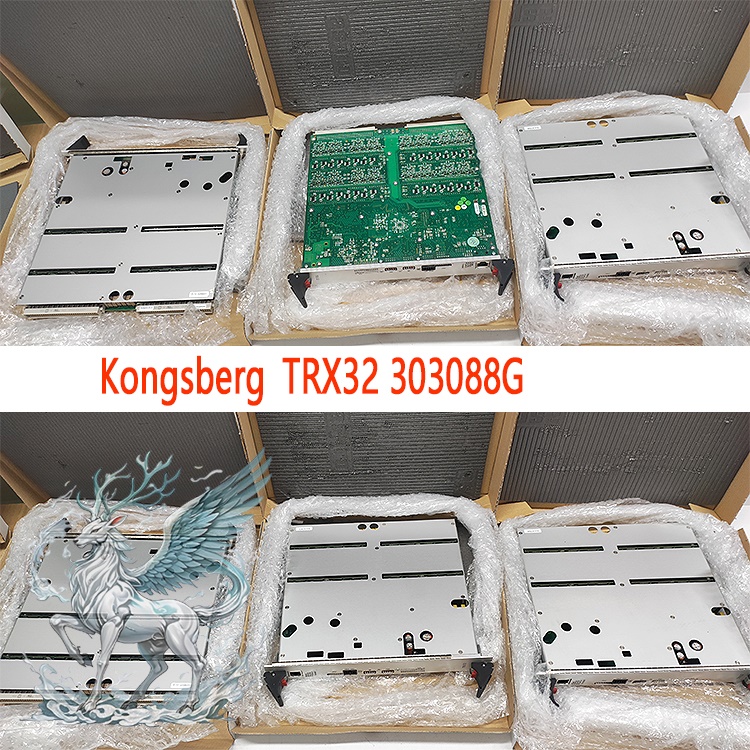
specific product photos; we can arrange for warehouse staff to take and verify
images.
We operate 76 shared warehouses
globally, so it may sometimes take a few hours to provide an accurate response;
we appreciate your understanding. Rest assured, we will address your inquiries
as quickly as possible.
Alternative
names for 303088:
303088
Input/Output Unit
303088
Marine Transceiver
303088
PCB Module
The
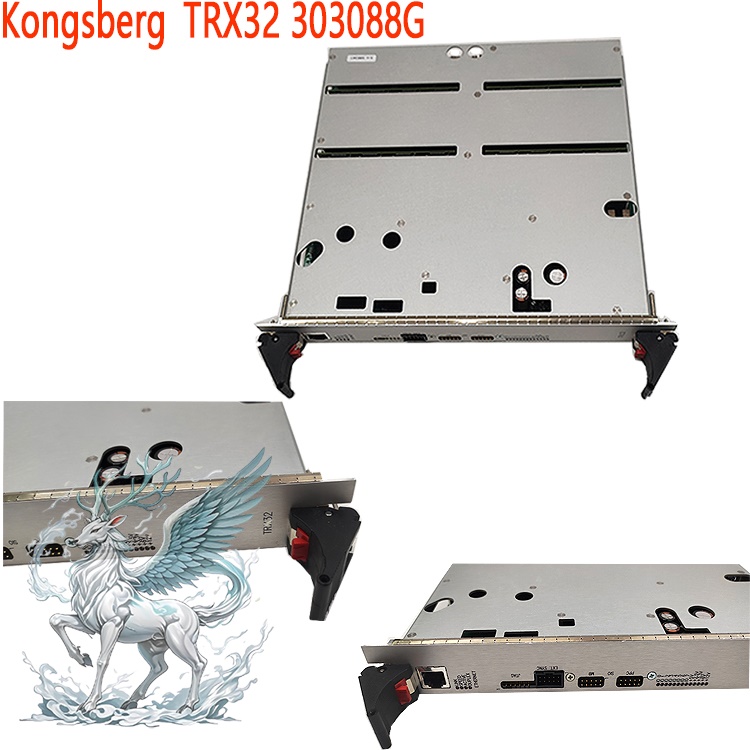
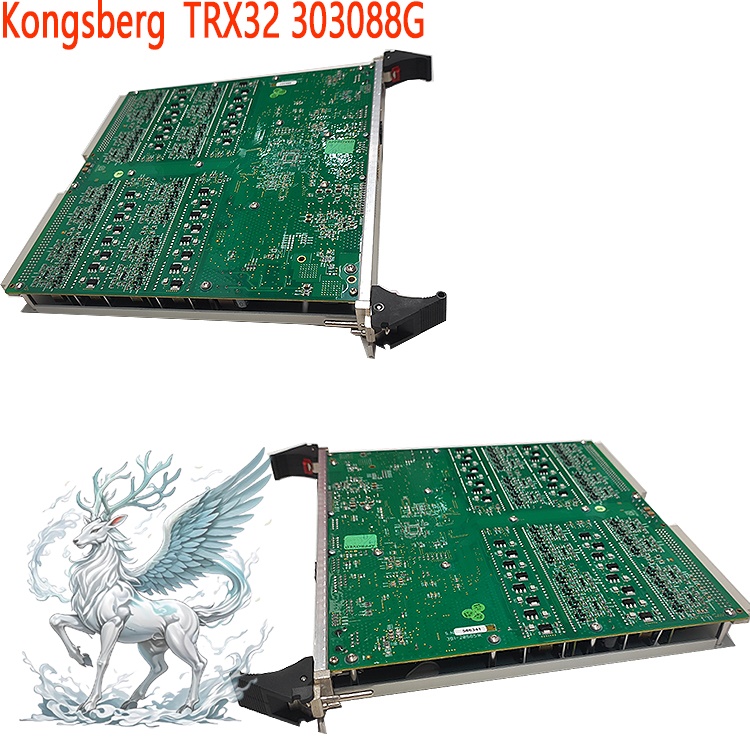
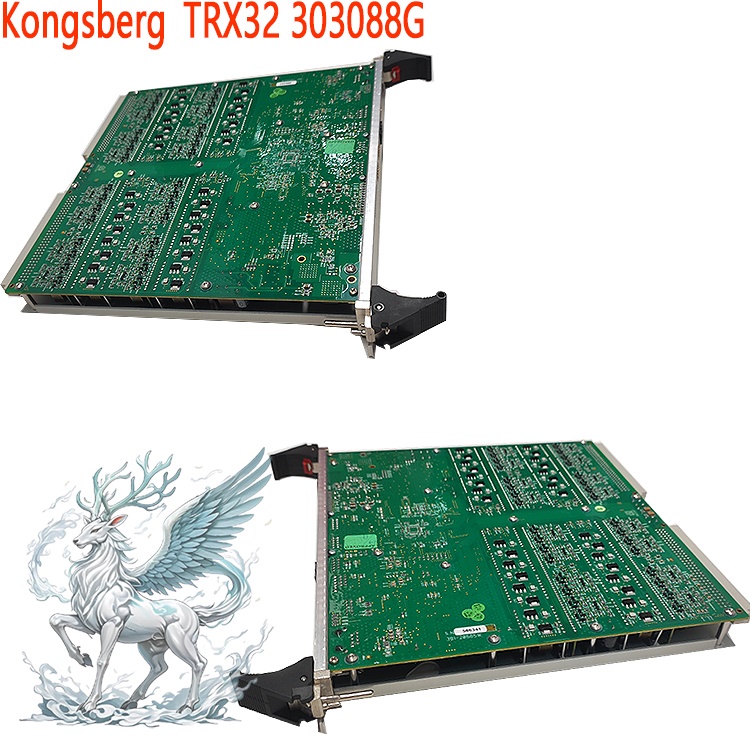
Kongsberg 303088 is a core 32-channel, multi-frequency acoustic transceiver board
for the Kongsberg Maritime HiPAP series of high-precision underwater acoustic
positioning systems. Classified as a Line Replaceable Unit (LRU), it is
compatible with the HiPAP 101/351/451/501 (X81 series) acoustic transceiver
housings, allowing for channel capacity expansion by integrating up to eight
303088 boards within a single cabinet. The board features a marine-grade
conformal-coated PCB, a reinforced metal shielding cover, and an extraction
latch. It performs underwater acoustic pulse transmission, echo acquisition, and
digital signal preprocessing, providing the host positioning system with raw
acoustic data—such as range and bearing—relative to underwater transponders. It
serves as critical hardware in the underwater acoustic measurement chain of
offshore dynamic positioning systems.
I.
Operating Principle
The
303088 board integrates 32 independent transmit channels and 32 receive channels,
with each transmit-receive pair corresponding to a specific element in the
transducer array. The operational workflow comprises three main components: the
transmit chain, the receive chain, and digital processing/system
synchronization.
Transmit
Chain: The HiPAP master control computer sends acoustic pulse commands, encoding
sequences, and operating frequency parameters to the 303088 via Ethernet. The
board's DSP and timing circuitry generate multi-frequency excitation pulse
signals based on configuration settings; these signals pass through a power
amplification circuit to drive the underwater transducer array, emitting
ultrasonic pulses. An onboard high-capacity energy storage capacitor array
ensures stable instantaneous transmission power. The board features two fuses
(F1: 12V/4A; F2: 6V/4A) in the transmission circuit to provide overload
protection and prevent damage to board components caused by transducer short
circuits.
Reception
Link: Weak acoustic echoes reflected from seafloor transponders or beacons are
converted into analog electrical signals by the transducer and fed into the
303088 reception channel. The signals first enter a low-noise pre-amplifier for
amplification, followed by band-pass filtering to eliminate marine environmental
noise and electromechanical interference from the vessel. Subsequently, a
high-speed ADC digitizes the analog echo signals, performing sampling,
decimation, and preliminary decoding to extract the transponder's encoded signal
and propagation delay information.
.jpg)
Synchronization
and Data Upload: The board receives the system's 20MHz master clock and an
external "TXENABLE" trigger synchronization signal, ensuring strict timing
alignment across multiple 303088 boards and transducer arrays. Pre-processed
digital acoustic measurement data is uploaded via the board's Ethernet interface
to the HiPAP host unit. The host performs beamforming using multi-channel delay
data to calculate the bearing, slant range, and 3D coordinates of underwater
targets (such as ROVs, AUVs, subsea pipelines, and underwater structures).
Finally, the data is fed into the vessel's K-Pos dynamic positioning system for
closed-loop position calculations. The board's front panel includes indicators
for Ethernet link status, data activity, and I/O status to facilitate real-time
local diagnostics; it also provides a P4 external synchronization interface and
P5/P7 debugging serial ports for engineering commissioning and external trigger
connections.
II. Application Fields and Scenarios
The
303088 is designed exclusively for use with the Kongsberg HiPAP high-precision
acoustic positioning system. It is primarily deployed on offshore oil and gas
vessels and marine engineering vessels to provide underwater position references
for Dynamic Positioning (DP) systems:
ROV/AUV
Tracking and Positioning: Offshore vessels equipped with the HiPAP system
utilize the 303088 to drive transducers for real-time tracking of underwater
robots (ROVs/AUVs), supporting operations such as subsea pipeline inspection,
wellhead maintenance, and subsea installations.
.jpg)
Underwater
Structure Monitoring: Positioning and monitoring of subsea pipelines, underwater
pile foundations, and floating platform mooring lines using underwater
transponders to determine the 3D positions of subsea facilities and monitor
displacement and settlement.
Offshore
Dynamic Positioning (DP): Drilling platforms, pipe-laying vessels, and
heavy-lift vessels rely on HiPAP acoustic positioning as a position reference
source for their DP systems. The 303088 handles acoustic signal acquisition,
ensuring the vessel maintains its position even in environments where GPS
signals are unavailable.
Hydrographic
Surveying and Marine Engineering Surveys: Measurement of underwater beacon
arrays and calibration of seabed reference arrays, providing sub-degree bearing
measurement capabilities to meet high-precision marine surveying
requirements.
Equipment
Maintenance and Spare Part Replacement: On-site repair of HiPAP systems; damaged
303088 cards can be replaced directly without returning the entire unit to the
factory, thereby minimizing offshore downtime.
III.
Operating Procedures
Prerequisites:
Strictly adhere to the Kongsberg HiPAP original equipment manufacturer (OEM)
maintenance manual. Operations must be performed only by certified offshore
equipment engineers. Hot-swapping (inserting or removing) cards is prohibited
while the vessel is in DP operation mode, except in emergencies.
(I)
Card Removal Procedure
System
Preparation: Notify the DP operator to switch the HiPAP system to an alternative
position reference source and isolate the relevant channels in the X81
transceiver cabinet. Turn off the power supply to the cabinet and wait for the
card's energy-storage capacitors to fully discharge (observing the static
discharge time specified by the OEM).Cable Removal: Disconnect all external
cables attached to the board's front panel—including Ethernet, synchronization
(P4), and debug serial ports (P5/P7)—and label the cables with their
corresponding identifiers.
Unlocking
and Extraction: Press the red release knobs on both sides of the board, operate
the upper and lower ejector levers to disengage the board from the backplane
slot, and slide the 303088 board out steadily and horizontally; take care to
avoid bumping the shielding cover or the capacitor array on the board.
.jpg)
Storage:
Place the removed board into an anti-static bag and store it in a dry,
shock-proof spare parts box; do not stack bare boards directly on top of one
another.
(II)
Board Installation Procedure
Anti-static
Protection: Wear an anti-static wrist strap; verify that the spare part model is
303088 and check the hardware version.
Rail
Alignment: Slide the board horizontally into the slot along the rack rails,
ensuring the backplane connectors are aligned; press the ejector levers on both
sides until the board is fully locked and the red locking latches reset.
Cable
Reconnection: Reconnect the Ethernet, external synchronization, and debug
interface cables in the order indicated by the labels.
DIP
Switch Configuration: Configure the board ID address using the SW1 and SW2 DIP
switches on the front panel; ensure that addresses do not conflict when multiple
303088 boards are installed in the same chassis.
Power-up
and Self-test: Power on the cabinet and observe the status of the power,
Ethernet, and I/O indicators on the front panel; access the hardware diagnostics
interface on the HiPAP host computer and perform board identification, channel
self-tests, and transducer circuit tests.
System
Calibration: After replacing the board, perform HiPAP acoustic channel gain and
time-delay calibrations, verify that positioning data output is normal, and
switch back to DP online mode.
(III) Routine Online Operations
During
normal system operation, engineers may only monitor the 303088 status via the
host computer—reading channel signal amplitudes, noise levels, board
temperatures, supply voltages, and F1/F2 fuse statuses. Remote adjustment of
transmit power, receive gain, and operating frequency parameters is permitted;
however, modifying hardware DIP switch settings while the system is online is
strictly prohibited.
IV.
Precautions
1.
Electrostatic Protection
The
303088 integrates numerous precision semiconductor components (such as DSPs and
ADCs) that are highly sensitive to static electricity. All disassembly,
assembly, and testing operations must be performed while wearing a certified
anti-static wrist strap and using a grounded workbench. Touching the pins,
capacitors, or chip areas on the back of the board is prohibited. Anti-static
packaging must be used throughout the transport and storage of spare parts;
handling bare boards in high-static, dry environments is strictly forbidden.
Electrostatic discharge (ESD) can cause latent component damage—faults may not
be immediately apparent but can lead to failure following vibration caused by
sea conditions.
2.
Electrical Safety
The
board contains high-capacity energy-storage capacitors that retain high voltage
after power-off. You must wait for the specified discharge time after
disconnecting power before removing the board to prevent electric shock or
damage to the backplane interface caused by arcing.
Channel
outputs must never be short-circuited while unloaded; damaged or short-circuited
transducer cables can instantly burn out the board's transmit channels or blow
the F1/F2 fuses. Always measure the insulation and impedance of transducer
cables before performing maintenance.
The
supply voltage must remain within the rated range specified on the nameplate.
Fluctuations or surges in the ship's power grid can cause DSP reboots or
hardware damage; the power protection module at the cabinet input must be
inspected regularly.
3.
Environmental and Mechanical Precautions
The
board is a marine rack-mount LRU (Line Replaceable Unit). Although it features
vibration resistance and protective coatings against salt spray and
environmental hazards, it must not be removed from the cabinet and exposed to
the humid, salt-laden air of the deck. Adequate ventilation must be maintained
inside the cabinet, and dust filters must be cleaned regularly to prevent dust
accumulation from causing the board to overheat. Insert and remove the card
horizontally; do not tilt or use force to pry it, as this can bend the backplane
connector pins. Do not remove the metal shielding cover, as it is crucial for
suppressing electromagnetic interference affecting acoustic signals.
4.
System and Configuration Risks
Within
the same X81 chassis, DIP switch IDs for multiple 303088 cards must not be
duplicated; ID conflicts prevent the system from recognizing the cards and cause
acoustic channel errors.
Channel
calibration must be performed after replacing a card; putting the system online
without doing so introduces ranging and bearing errors, leading to abnormal DP
positioning and compromising vessel operational safety.
The
card is a core safety-critical component of the HiPAP system; the use of
non-original firmware or third-party modifications is strictly prohibited, as
incorrect firmware flashing can render the card unusable.
5.
Fault and Spare Parts Management
Diagnose
card faults via the host computer first to distinguish between issues with the
card itself, the transducer, the cable, or the backplane; do not replace the
card blindly.
Control
temperature and humidity in spare parts storage to avoid high temperatures and
condensation; different hardware versions of the 303088 cannot be used
interchangeably, so version numbers must be verified when purchasing spares.
When
returning a faulty card, retain the original shielding cover and anti-static
packaging, keep a record of the fault, and submit it to Kongsberg for official
repair assessment.
6.
Operational Safety Management
During
vessel DP operational windows, hot-swapping is prohibited unless the card has
completely failed. Before performing card maintenance, obtain a work permit,
notify the central control room and DP operators, and ensure a redundant
switchover of position references to prevent vessel drift accidents caused by
the loss of acoustic positioning.
V.
Summary
The
303088 serves as the signal transceiver core of the HiPAP acoustic positioning
system. By utilizing 32-channel multi-frequency signal generation, acquisition,
and digital pre-
processing,
it enables high-precision acoustic ranging and bearing determination for
underwater transponders, supporting offshore dynamic positioning and underwater
target tracking. This circuit board is a piece of high-precision marine acoustic
hardware; its operation and maintenance must strictly adhere to protocols
regarding anti-static measures, discharge procedures, and system calibration. In
the harsh operating conditions found at sea, proper cabinet maintenance,
standardized installation and removal procedures, and rigorous version control
of spare parts are essential to ensuring the continuous and reliable operation
of the HiPAP system.
Recommended
related products:
3BHE032025R1101
PCD235
3BHE032025R1101
PCD235
PCD235
3BHE057901R0101
3BHE057901R0101
PCD235
3BHE028915R0101
PCD237A1011
3BHE028915R0101
PCD237A1011
3BHE041343R0102
PCD530A
PPD103B101
3BHE020455R0101
3BHE017628R0002
PPD115
3BHE017628R0102
PPD115
PPD115A102
3BHE017628R0102
PPD117A3011
3BHE030410R3011
3BHE040375R1023
PPD512
PPD512A10-15000
3BHE040375R1023
PPD512A10-454000
3BHE040375R103E
3BHE039724R0C4A
PP D513A0C
PP
D513 A0C-110440 3BHE039724R0C4A
PPD513
A0E-110110 3BHE039724R0E41
3BHE039724R0E41
PPD513
More......


 ABB
ABB GE
GE HONEYWELL
 TRICONEX
 KONGSBERG
 EMERSON
 FOXBORO
 MOTOROLA
 VIBRO-METER
 ICS TRIPLEX
 WOODWARD
 BENTLY NEVADA
 OTHER
OTHER Home
Home.jpg)
.jpg)
.jpg)



.jpg)