All products on this website are
specialized items subject to fluctuating market prices.
Please rely on the quote provided by
customer service, as the listed prices are not final.
Before placing an order, please confirm
details such as the model, product specifications, and pricing with customer
service.
Please contact customer service for
inquiries regarding available units.
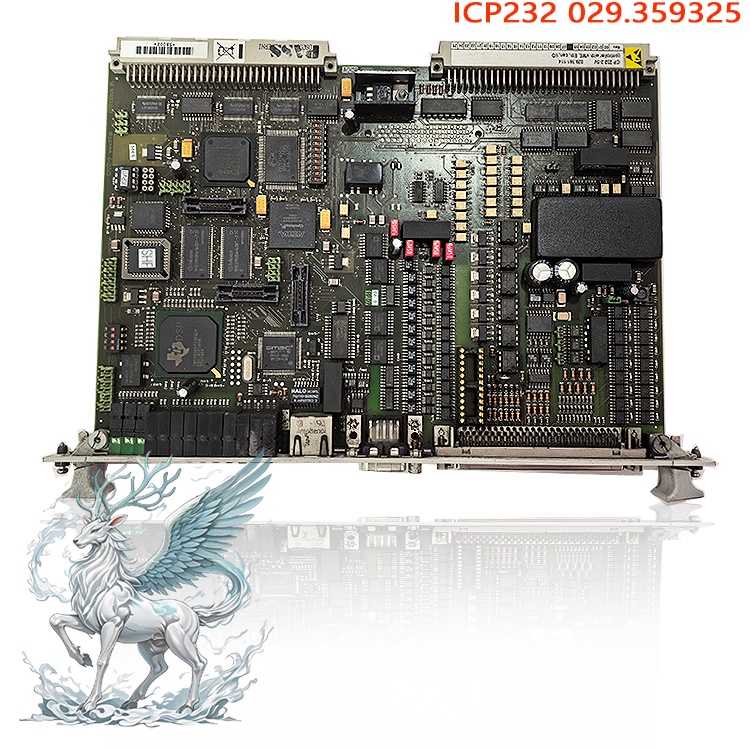
ICP232 Alternative Name:
Industrial-grade
logic processing unit ICP232
I.
ICP232 Single Processor Unit: Operating Principle
The
ICP232 Single Processor Unit is
equipped with an industrial-grade embedded processor and a dedicated real-time
operating system. Utilizing a deterministic time-division task scheduling
mechanism, it serves as the computational and logic hub of the entire control system.
The unit's workflow begins with signal acquisition: digital and analog
signals—as well as device status data—from field sensors, I/O acquisition modules, and subsystems are transmitted to the processor
core via corresponding bus interfaces. The board performs signal filtering,
protocol parsing, and data preprocessing before executing preset logic
operations, closed-loop control algorithm calculations, and safety interlock
logic verification. Specific signal-processing models feature built-in 2oo3
(two-out-of-three) voting logic, which verifies the consistency of multi-channel
calculation results to ensure the safety of control outputs. To guarantee
operational reliability, the ICP232 integrates a hardware watchdog,
ECC
memory error correction, and circuits for clock monitoring and power supply
inspection; it conducts comprehensive self-diagnostics on operational status,
hardware parameters, and end-to-end communication status at fixed intervals,
continuously verifying the accuracy of calculation results. Upon completion of
processing, the unit issues control commands to field output modules and
actuators while simultaneously synchronizing operational data, event logs, and
fault information with upper-level monitoring systems and adjacent control nodes
via industrial bus interfaces. When the unit detects internal hardware
anomalies, deviations in computational results, or communication link failures,
it automatically triggers a hardware-level safety fail-safe mechanism. This
forces the system into a preset safe state and blocks hazardous outputs, thereby
ensuring the safety of field equipment and personnel at the hardware level.
II.
Core Application Areas of the ICP232 Single Processor Unit
The
ICP232 Single Processor Unit is deployed across various industries requiring
high safety integrity levels, with core applications concentrated in three major
sectors: rail transportation, power generation, and vehicle control.
(i)
Rail Transportation Signaling
The
ICP232 serves as the core processing component for railway signaling systems.
Specifically, the ICP232 model has achieved SIL4 safety integrity certification
under the EN 50129 standard. It is compatible with high-speed railway ETCS Level
2 train control systems, metro CBTC systems, station computer interlocking
systems, and freight marshalling yard interlocking systems. It performs core
logic processing tasks such as track occupancy analysis, route interlocking,
signal control, and safety speed limit calculation, while supporting movement
authority processing at speeds up to 320 km/h. Additionally, it facilitates
integrated control for tunnel safety monitoring, platform screen door linkage,
and emergency evacuation systems, making it suitable for diverse operational
environments including metros, suburban rapid transit, high-speed railways, and
mountain railways.
(ii)
Power Generation Control
In
the power industry, the ICP232 unit is compatible with the Alstom Alspa 600 DCS
control system. It is applied to auxiliary equipment control and unit protection
systems in thermal power plants, hydroelectric stations, and combined-cycle
power plants. It handles functions such as boiler auxiliary sequence control,
turbine guide vane control, and unit status monitoring and protection
interlocking. Capable of operating in environments with generator harmonic
interference, it ensures control stability during unit startup, shutdown, and
operation, and is also suitable for control system upgrades and retrofits for
aging power generation units. (III) Locomotive On-board and Industrial Control
Sectors
.jpg)
On-board
models such as the ICP232 comply with the EN 50155 standard for railway rolling
stock equipment. They are suitable for applications including locomotive
traction control systems, vehicle braking systems, door control, and on-board
diagnostic systems, enabling real-time control and monitoring of locomotive
operating status. Additionally, the unit can be deployed in metallurgical
production lines, oil and gas refining units, port hoisting equipment, and
marine propulsion control systems; its robust resistance to vibration and
electromagnetic interference allows it to operate reliably in various harsh
industrial environments.
III.
Installation and Maintenance Considerations for the ICP232 Single Processor
Unit
The
ICP232 is a safety-related control component; its installation and maintenance
must strictly adhere to established specifications to ensure stable operation
and the effectiveness of safety functions. During installation and deployment,
the specific sub-model must be matched to the appropriate environmental
conditions: the signal-specific model operates within a temperature range of
-40°C to +85°C, while the on-board industrial model operates between -40°C and
+70°C. Installation locations must be free from dust, condensation, and
corrosive gases. Cabinets must be equipped with shock-absorption devices to
minimize vibration-induced damage to solder joints and components during
operation and transport, ensuring compliance with IEC 61373 vibration and shock
standards. Power supply specifications must be strictly observed; standard
models utilize 24V DC power with an allowable voltage fluctuation of ±20% of the
rated value, and surge protectors and electrical isolation devices should be
installed on the power supply side. A single-point grounding system must be
used, with high-voltage circuits and low-voltage signal circuits grounded
separately to prevent electromagnetic interference from compromising signal
accuracy and operational stability. Hot-swapping of boards is strictly
prohibited during routine operation to prevent bus short-circuits that could
damage interface chips. Before performing firmware upgrades or control program
updates, a complete backup of existing configuration parameters and control
logic is mandatory, and firmware and hardware version compatibility must be
verified to prevent system failures caused by version mismatches. During
communication cabling, the shielding of bus cables—such as Ethernet, MVB, CAN,
and RS-422—must be reliably grounded, and terminal resistors of the appropriate
impedance must be installed at bus ends in accordance with specifications to
prevent signal reflections that could cause packet loss or data jitter. When
replacing spare parts or performing maintenance, it is essential to verify the
hardware version and part number of the circuit boards; interface definitions
and logic functions vary between sub-models, so they cannot be interchanged
indiscriminately. Anti-static wrist straps must be worn when handling or
touching boards to prevent electrostatic discharge (ESD) from damaging chips and
causing latent, intermittent faults. Commissioning and maintenance personnel
must undergo specialized training for the relevant systems, and unauthorized
modification of safety interlock logic parameters is strictly prohibited.
Routine operations and maintenance should include regularly reading internal
diagnostic logs and cross-referencing them with panel status indicators to
anticipate potential faults and address hazards proactively.
IV.
Industry Advantages of the ALSTOM ICP232
Among
similar industrial processors, the ALSTOM ICP232 holds a
significant competitive advantage due to its performance in safety,
environmental adaptability, real-time capability, and reliability. It leads the
industry in safety performance; signal-specific models have achieved SIL4 Safety
Integrity Level certification under the EN 50129 standard. Utilizing a
hardware-level fail-safe architecture and "2oo3" (two-out-of-three) voting
logic, the unit boasts a probability of dangerous failure far lower than
standard industry products, making it fully capable of meeting the rigorous
demands of safety-critical sectors—such as rail transit and power systems—and
satisfying the highest safety standards for mission-critical applications. Its
environmental adaptability is at the forefront of the industry; the unit employs
industrial-grade, wide-temperature components and a ruggedized structural
design. Compliant with multiple international standards—including EN 50129, EN
50155, and IEC 61373—it withstands extreme temperatures, shock, vibration, and
strong electromagnetic interference. This enables stable, long-term operation in
harsh environments such as underground tunnels, trackside locations, and remote
outdoor power stations, thereby reducing equipment failures caused by
environmental factors. The system delivers exceptional real-time control
performance by employing a deterministic time-division task scheduling
mechanism; its core control
response time reaches the millisecond level, meeting the demands of
high-precision, real-time applications such as train braking control and steam
turbine speed regulation. It incorporates an ECC memory error-checking and
correction mechanism to effectively prevent malfunctions caused by memory soft
errors, thereby further enhancing operational reliability. Comprehensive,
end-to-end self-diagnostic capabilities allow for real-time monitoring of
hardware, computation, and communication links,
.jpg)
as
well as the automatic recording of fault timing data; this assists maintenance
personnel in rapidly pinpointing faults, significantly reducing troubleshooting
and downtime, and minimizing production losses associated with unplanned
outages. The system offers extensive interface compatibility, natively
supporting mainstream industrial buses and communication protocols—such as
Ethernet, MVB, CAN, and RS-422—and enabling direct integration with Alstom’s I/O
modules and third-party field devices. This ease of integration makes it highly
adaptable for both new control system installations and the retrofitting of
legacy units. The product offers distinct advantages across its entire
lifecycle: core components are selected for industrial-grade longevity,
resulting in a Mean Time Between Failures (MTBF) far exceeding industry averages
and an extended service life. Furthermore, long-term official spare parts
support ensures the system meets the decades-long operational requirements of
critical infrastructure sectors—such as power generation and rail transit—while
reducing total lifecycle maintenance costs.
Recommended
related products:
3BHE020455R0103
PPD103
Kongsberg
303088
Kongsberg
303088G
3BHE032025R1101
PCD235
PCD235
3BHE057901R0101
3BHE057901R0101
PCD235
3BHE028915R0101
PCD237-A1011
3BHE028915R0101
PCD237-A1011
3BHE041343R0102
PCD530A
3BHE02384R2630
PPD103
3BHE020455R0101
PPD103B
3BHE020455R0103
PPD103
More......
1.Do you offer global shipping?
Yes. We have local distribution centers on every continent, enabling us to quickly ship parts to anywhere in the world.
2. What payment methods and currencies do you accept?
To make your purchasing process as simple and convenient as possible, we offer a variety of payment methods, including bank transfer, cheque, and PayPal. We also accept most major credit and debit cards, such as Visa, Mastercard, and American Express. We accept payments in most major global currencies, but we recommend using US Dollars (USD), British Pounds (GBP), or Euros (EUR). Using other currencies may incur additional fees. All transactions are securely processed by HSBC and HSBC Merchant Services.
3.How much parts do you currently have in stock?
We have a vast inventory of new, refurbished, and used automation components, including products from well-known manufacturers such as ABB and Schneider Electric. If you can't find the part you need, don't worry. We work closely with professional suppliers worldwide, and even if the part you need isn't listed on our website, we can provide you with a tailored quote.
4.Who should I contact if I encounter any problems?
Our experienced customer service team will handle any issues after you place your order.


 ABB
ABB GE
GE HONEYWELL
 TRICONEX
 KONGSBERG
 EMERSON
 FOXBORO
 MOTOROLA
 VIBRO-METER
 ICS TRIPLEX
 WOODWARD
 BENTLY NEVADA
 OTHER
OTHER Home
Home
.jpg)
.jpg)