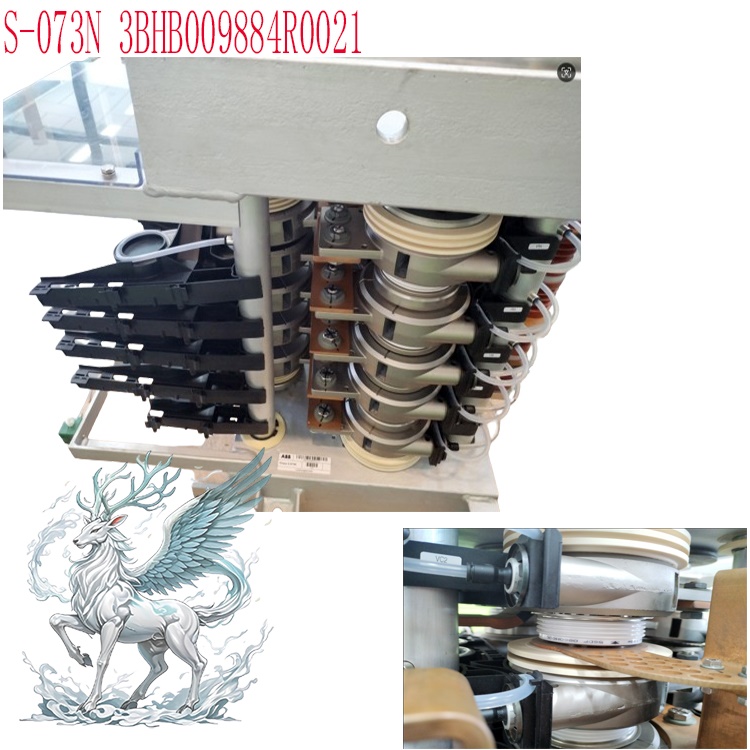
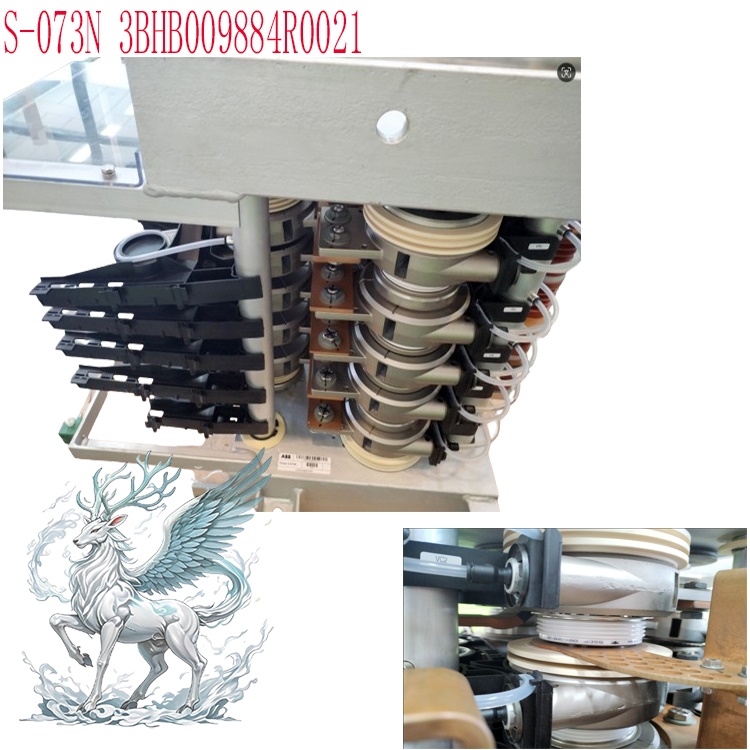
Many products are not yet listed. Please contact us for more
information.
If the product model differs from the displayed image, the model number
shall prevail. Please contact us for specific product images; we will arrange to
take photos in our warehouse for confirmation.
We have 76 shared warehouses worldwide, so it may sometimes take several
hours to accurately return the information to you. We apologize for any
inconvenience. Of course, we will respond to your inquiries as soon as
possible.
3BHB009884R0021 Other Names:
High Voltage Power Electronic Phase Module 3BHB009884R0021
3BHB009884R0021 ACS 6000 Medium Voltage Driver
PCS 6000 Advanced Console Server 3BHB009884R0021
I. Functions
This rack is the core of the ACS6000 system's power conversion, undertaking
the following functions:
First Layer: Power Form Conversion
The rack internally houses multiple IGCT (Integrated Gate Commutated
Thyristor) power modules, models 5SHY3545L0016 and 5SHY4045L0006. Each IGCT module, in conjunction with anti-parallel diodes, forms a complete power
switching pair. The PPD517A3011 pulse distribution board within the rack
receives PWM commands from the PM645B controller and precisely controls the
on/off state of each IGCT according to the switching sequence of the three-level
topology. The DC bus voltage (typically 2300V to 4160V, depending on the system
voltage level) is cut by the IGCT modules according to a sinusoidal PWM pattern,
synthesizing a three-phase stepped multi-level output voltage. The equivalent
sinusoidal distortion (THD) of this output voltage is typically below 5%, far
superior to the 15% to 20% of traditional two-level inverters. Therefore,
motor-side harmonic losses are significantly reduced, motor temperature rise is
lower, and insulation life is longer.
.jpg)
Second Layer: Direct Torque Control (DTC)
The ACS6000 uses ABB's patented Direct Torque Control algorithm, rather
than traditional vector control. DTC achieves high-precision torque control
without the need for resolver or encoder feedback. The PM645B controller
calculates the actual values of stator flux and electromagnetic torque every
25 microseconds and compares them with the given values. It directly selects the
optimal IGCT switching state using a hexagonal flux meter and torque comparator.
This means the delay from a given torque change to the actual torque response is
only 1 to 2 milliseconds, far faster than the 10 to 20 milliseconds of vector
control. For operating conditions requiring extremely high instantaneous torque,
such as starting up a ball mill in a mine or during the moment of steel biting
in a rolling mill, the advantages of DTC are extremely obvious.
Third Layer: Power Unit Level Management and Redundancy
The rack does not contain only one IGCT module, but rather multiple power
units connected in series. Each power unit includes a set of IGCT modules, a set
of driver boards PPD512A10-45400 or PPD513AOC-100440, and a set of voltage
detection circuitry. The pulse distribution board PPD517A3011 is responsible for
distributing the unified PWM signal from the controller to the driver boards of
each power unit. When the IGCT module of a power unit fails, the driver board of
that unit will automatically block its output in the next switching cycle. The
PM645B controller then recalculates the switching sequence of the remaining
units, and the system automatically operates at reduced derating. In a typical
configuration, even after losing one unit, the system can still output over 90%
of its rated power without shutting down. This is significant for continuous
production enterprises (such as steel mill rolling lines and main conveyor belts
in mines), preventing huge economic losses caused by unplanned downtime.
Fourth Layer: Signal Acquisition and System Protection
The voltage detection board PVD164A2059 acquires the DC bus voltage, output
voltage of each phase, and output current in real time. The acquired data is
used for closed-loop feedback of the DTC algorithm and for triggering protection
logic. Protection includes, but is not limited to: DC overvoltage protection
(tripping when the bus voltage exceeds the threshold due to braking energy
feedback), AC overcurrent protection (tripping when the output current exceeds
150% of the rated value for 200 milliseconds), IGCT overtemperature protection
(derating when the temperature exceeds 55°C and tripping when the temperature
exceeds 65°C, monitored by a water-cooled temperature sensor), and water-cooled
fault protection (immediately tripping and blocking the IGCT when the water flow
rate is lower than the set value or the water temperature exceeds 45°C). All
protection actions are uploaded to the control unit and output to the DCS system
via the GFD563A101 and GFD563A102 I/O modules.
.jpg)
Layer : Communication and External Interfaces
The rack provides a Profibus DP interface via the CI858K01 module, a Modbus
TCP/IP interface via the CI867AK01 module, and an RS232/RS485 serial port via
the PCD232 module. These interfaces allow the upper-level DCS or PLC to read
real-time data such as the rack's operating status, fault codes, and motor
current and voltage, and to issue start/stop commands, speed commands, and
torque commands. Communication latency under Profibus DP is typically less than
10 milliseconds, meeting real-time control requirements.
Layer : Excitation Control (When Configured with a Synchronous Motor)
When driving a synchronous motor, the integrated excitation control board
PFSA140RULLM7A and excitation controllers PM891/PM891K01/PM891K02 within the
rack are responsible for providing adjustable DC excitation current to the motor
rotor. The magnitude of the excitation current directly affects the motor's
power factor. By adjusting the excitation, the synchronous motor can operate
with a leading power factor, feeding reactive power back to the grid, improving
the overall power factor of the plant, and reducing the investment in reactive
power compensation capacitors. This is particularly important in large-scale fan
and pump applications in the power industry.
Multi-level PWM Output: Employing a three-level topology, it outputs a
near-sine wave multi-level PWM voltage, significantly reducing motor harmonic
losses and dv/dt stress.
Real-time Control Execution: Receives torque and flux commands from the
upper-level controller (PM645B/PM644, etc.) and controls the on/off timing of
the IGCT via the drive board (PPD517A3011 pulse distribution board,
PPD512A10/PPD513AOC power unit drive board).
Voltage and Current Detection: Real-time acquisition of DC bus voltage and
output voltage via the PVD164A2059 voltage detection board, feeding back to the
controller for closed-loop regulation. Section
Excitation Control Support: The rack can be configured with
PFSA140/PM891/PFSA140RULLM7A excitation control boards to provide excitation
current to the synchronous motor.
II. Usage Method:
System Configuration: This rack is part of the INU (Inverter Unit) in the
standard single-drive configuration of the ACS6000 system. It needs to be used
in conjunction with LSU (Linear Power Supply Unit/12-Pulse Rectifier), ARU
(Active Rectifier Unit, optional), TEU (Termination Unit), CBU (Capacitor Bank
Unit), WCU (Water Cooling Unit), and COU (Control Unit) to form a complete drive
system.
Software Tools: Parameter settings and debugging require ABB Control
Builder or Automation Builder engineering software. Connection is required via a
fiber optic programming tool (RUSB-02 or PCMCIA equivalent). Laptops must have
DriveDebug and DriveWindow pre-installed.
Phase One: Installation and Wiring:
After the rack arrives on site, first confirm that the rack model matches
the order form and check for any collision damage during transportation. The
rack should be installed in a closed metal cabinet. The cabinet dimensions must
meet the installation drawings provided by ABB, and at least 800 mm of
maintenance space must be provided in front of and behind the rack. The bottom
of the rack is bolted to the cabinet base plate, and the fixing torque must be
in accordance with the values specified in the installation manual (usually 45
Nm for M12 bolts).
Wiring work must be performed by a qualified electrician with a license.
Main circuit wiring includes: DC bus positive and negative cables
(cross-sectional area selected according to current rating, typically 240 mm² to
630 mm² copper cable), and three-phase output cables to the motor
(cross-sectional area selected according to the motor's rated current, taking
into account harmonic derating factors, typically multiplied by 0.86). The
control circuit wiring includes: IGCT drive fiber optic cable (from PPD517A3011
to each PPD512/PPD513, must use original ABB fiber optic cable, the bending
radius must not be less than 30 mm), voltage detection line (from PVD164A2059 to
DC bus and output side PT), water cooling pipeline (the inlet and outlet must be
connected in the direction of the arrow, and cannot be reversed), and
communication cable (Profibus must use shielded twisted pair cable, and the 120
ohm terminating resistor is connected to the last node).
After all wiring is completed, perform insulation testing. Use a 2500V
megohmmeter to measure the insulation resistance of the main circuit to ground;
it must be greater than 10MΩ. Use a 500V megohmmeter to measure the insulation
resistance of the control circuit to ground; it must be greater than 1MΩ. The
grounding resistance must be less than 4 ohms.
Second Stage: Pre-Power-On Inspection (Cold Commissioning
Prerequisites)
Check the water cooling system: Confirm that the resistivity of the
deionized water is greater than 100kΩ·cm, confirm that the water flow sensor
reading is normal (typical flow rate is 15 to 25 liters/minute), and confirm
that the inlet water temperature is between 20°C and 30°C. Open the water
cooling system vent valve to purge air from the pipes until a continuous flow of
water without air bubbles flows from the outlet.
Check the fan: There is a forced-air cooling fan inside the rack. Confirm
that the fan blades are not obstructed by foreign objects, and manually rotate
the blades to confirm that they rotate freely without jamming.
Check the circuit boards: Visually inspect all circuit boards to ensure
they are firmly inserted, the gold fingers are free of oxidation, and the board
fixing screws are not loose. Pay special attention to the PPD517A3011 pulse
distribution board and the PPD512/PPD513 driver boards. Poor contact on these
two types of boards can lead to IGCT false triggering or even tube failure.
Inspect the IGBT/IGCT modules: Visually inspect the 5SHY3545L0016 and
5SHY4045L0006 modules for cracks and burn marks. Ensure the thermal grease
between the heatsink and the water-cooling plate is even and not dried out.
Third Stage: Power-On and Parameter Download
Close the main circuit breaker in the cabinet to power on the control
circuit. The power indicator light on the rack panel should illuminate (usually
green).
Use a laptop to connect to the rack's fiber optic interface using the
ABB-provided RUSB-02 USB-to-fiber optic adapter. The laptop must be
pre-installed with ABB DriveWindow software (ACS6000 specific version) and
DriveMonitor software.
Connect the PM645B controller via DriveWindow and read the current firmware
version. If the firmware version is lower than the project requirements, a
firmware upgrade is required. Firmware upgrades must be strictly performed
according to the upgrade procedures published by ABB, and power must never be
interrupted during the upgrade process.
After confirming the firmware is correct, download the project parameter
file. The parameter file includes: motor nameplate parameters (rated voltage,
rated current, rated frequency, rated speed, power factor, efficiency, moment of
inertia), IGBT/IGCT module parameters, control parameters (DTC flux and torque
bandwidth, current limit value, speed loop PI parameters, acceleration and
deceleration time), protection parameters (overcurrent threshold, overvoltage
threshold, overtemperature threshold, water cooling flow rate minimum limit),
and communication parameters (Profibus station address, baud rate, Modbus IP
address and port number).
If accurate motor parameter values cannot be obtained from the nameplate,
the self-identification function of the motor parameters built into DriveWindow
can be used. This function automatically measures the stator resistance, leakage
inductance, mutual inductance, and rotor time constant by injecting a
low-frequency pulse voltage into the motor. The motor must be unloaded during
the identification process, disconnected from the coupling.
Fourth Stage: No-Load Test Run
After the parameters are downloaded, perform an open-loop test without
connecting the motor. In DriveWindow, set the system to open-loop mode and
slowly increase the frequency setpoint (starting from 0Hz, increasing by 5Hz
each time, pausing for 30 seconds to observe the output voltage and current
waveforms). Use an oscilloscope to measure the three-phase output voltage,
confirming the correct three-level stepped waveform and consistent voltage
differences between adjacent levels. Use a clamp meter to measure the output
current; the current should be close to zero under no-load conditions (typically
less than 5% of the rated current).
After passing the open-loop test, switch to closed-loop mode and continue
no-load operation. Gradually increase the speed to 25%, 50%, 75%, and 100% of
the rated speed, pausing for 5 minutes at each level, monitoring the IGCT module
temperature, water-cooled outlet temperature, and DC bus voltage fluctuations.
Under normal conditions, the IGCT module temperature should be below 40°C and
the water-cooled outlet temperature should be below 35°C during no-load
operation.
Fifth Stage: Load Test Run
After confirming normal no-load operation, connect the motor and perform a
load test run.
During startup, set the acceleration time to 30 to 60 seconds (adjust
according to load inertia), accelerating from 0Hz to the rated frequency.
Observe the peak starting current. Under DTC control, the starting current is
typically 120% to 150% of the rated current, far lower than the 600% to 800% of
direct starting. Monitor motor vibration and noise during startup. If abnormal
vibration is detected, check the motor alignment and the rack output voltage
balance.
After reaching rated speed, gradually increase the load to 25%, 50%, 75%,
and 100%, running each speed for 30 minutes. Record the input power, output
power, power factor, motor current, IGCT temperature, and water cooling
temperature at each speed. Calculate the system efficiency. The ACS6000
typically achieves a system efficiency of 97% to 98.5% under full load.
Sixth Stage: Optimization and Handover
During trial operation, fine-tune the control parameters according to
actual operating conditions. For example, if the motor experiences significant
torque ripple at low speeds, appropriately reduce the DTC torque bandwidth (from
the default value of 30% to 20%); if the system response is too slow, increase
the torque bandwidth (to 40%), but accept greater current ripple.
After all tests are passed, a commissioning report is prepared, including:
wiring diagram, parameter list, trial operation data, and protection action
records. The system is then handed over to the owner's operators, and
operational training is completed. Operators must complete the ABB official
G761e online training course and pass the exam before they can operate the
system independently.
Phase : Daily Operation
Startup: Press the start button on the DCS or local HMI. The system
automatically performs pre-charge (DC bus capacitor charging, approximately 3-5
seconds), water cooling system self-test, and IGCT self-test. After all tests
pass, it automatically accelerates to the given frequency.
Stop: Press the stop button. The system decelerates to zero over the set
time (usually 30-120 seconds) and then blocks the IGCT output. After stopping,
the DC bus capacitor needs to discharge through the braking resistor, which
takes approximately 2-5 minutes. The cabinet door must not be opened during this
time.
Emergency Stop: Press the emergency stop button or trigger an external
emergency stop signal. The IGCT is immediately blocked, and the mechanical brake
(if configured) activates. After an emergency stop, the fault must be reset in
DriveMonitor before restarting.
Maintenance & Replacement
The power units feature a modular, hot-swappable design. Faulty units can
be individually removed and replaced while the system is operating at reduced
power.
After replacement, the firmware for that unit must be re-downloaded and
voltage equalization calibration performed.
III. Precautions
The water-cooling system is crucial: This rack uses closed-loop deionized
water cooling. An IGCT junction temperature exceeding 90 degrees Celsius will
trigger protection and reduce power; exceeding 125 degrees Celsius will trip the
circuit breaker. The inverter must not be started when the water-cooling system
is shut down; otherwise, the IGCT will burn out within seconds.
Strictly prevent electrostatic discharge (ESD): The IGCT module and driver
board are sensitive to ESD. When replacing modules, an anti-ESD wristband must
be worn, and the workbench must be grounded.
Fiber optic communication is non-hot-swappable: The PM645B connects to each
submodule via fiber optic cables. Unplugging or plugging the fiber optic cable
while the circuit is powered on will cause communication interruption and
malfunctioning protection.
The power-on sequence must not be reversed: The water cooling system must
be turned on first, followed by the control power, and finally the drive pulse
must be sent; the power-off sequence is the reverse. Reversing the order will
trigger system interlock protection.
Power Unit Failure Handling: After a single unit fails, the system
automatically bypasses that unit, reducing the output voltage by approximately
5%, allowing continued operation with reduced power. However, if the number of
bypassed units exceeds 20% of the total, the system must be shut down to prevent
overload of the remaining units.
Excitation System Notes: Synchronous motors require an excitation unit
(PFSA140/PM891); this is omitted in asynchronous motor configurations. Do not
mix and match wiring methods.
Fieldbus Configuration: Communication modules CI858K01 support Profibus DP,
and CI867AK01 supports Modbus TCP. Before configuration, ensure consistency with
the host system protocol, matching terminating resistors, and correct baud rate
settings.
Storage Environment: Spare modules should be stored in an environment with
a temperature between -25°C and +60°C, humidity below 95%, and no condensation,
avoiding direct sunlight.
Power Unit Redundancy: In the event of a single power unit failure, the
system can automatically disconnect that unit, while the remaining units
continue operating without shutdown. However, the faulty unit must be replaced
within 72 hours, otherwise the system will be derated or trip.
Board Replacement: Before replacing any board, power must be disconnected
and the DC bus capacitor must be fully discharged (usually requiring at least 15
minutes). Take precautions against static electricity during replacement; the
board slot orientation must not be reversed.
Communication Configuration: The Profibus terminating resistor must match
the master station, and the baud rate settings must be consistent. Verify that
the input signal range is within the module's range and troubleshoot grounding
interference.
Certification Requirements: Operators and commissioning personnel must
complete the ABB official G761e online course and pass the certification before
performing commissioning work.
Protection Level: The rack itself is IP00 designed and must be installed in
a closed cabinet. The cabinet must be kept clean, dry, and well-ventilated.
Prohibited Operations: Motor operation is prohibited before cold
commissioning is completed; forcibly starting the inverter is prohibited when
the water cooling system fails.
Safety Considerations:
The DC bus voltage inside the rack can reach up to 4160V. Even after power
failure, the DC bus capacitor can still store lethal charges. After power
failure, wait at least 15 minutes (until capacitor voltage drops below 60V)
before opening the cabinet door for operation. Before operation, a voltage
tester must be used to confirm no power. Any board replacement must be performed
with the power off; plugging or unplugging boards while the power is on is
strictly prohibited. Operators must wear insulated gloves and shoes and use
insulated tools.
Water Cooling System
The water cooling system is the lifeline of this rack. The junction
temperature of the IGCT module must be controlled below 125°C, relying entirely
on water cooling to remove heat. Water quality requirements are extremely
strict: resistivity must be greater than 100kΩ·cm (at 25°C), pH value 7 to 8,
and hardness less than 1ppm. Deionized or distilled water must be used; tap
water or mineral water is strictly prohibited. Water quality must be tested
quarterly; water must be replaced immediately if it fails to meet standards. The
system will alarm when the water flow rate is below 80% of the set value and
will trip when it is below 60%. The water cooling pipeline must be flushed
annually to remove rust and deposits from the inner walls. When shutting down in
winter, if the ambient temperature is below 0°C, the water in the pipes must be
drained or antifreeze must be injected; otherwise, freezing will cause the
water-cooled plate of the IGCT module to crack.
IGCT Modules
IGCT modules are the most expensive components in the rack, typically
costing tens of thousands of RMB per unit. IGCTs are extremely sensitive to
temperature; for every 10°C increase in junction temperature above the rated
value, their lifespan is reduced by approximately 50%. Therefore, it is
essential to ensure the water cooling system is always functioning properly.
Replacement of IGCT modules must be performed by an ABB-certified engineer.
After replacement, a voltage equalization test must be performed again to ensure
the difference in conduction voltage drop between the new and old modules is
less than 0.1V; otherwise, uneven current sharing will occur, potentially
causing overload damage to the new module.
Boards
All boards are electrostatic sensitive devices. Before replacing boards, an
anti-static wrist strap must be worn and the board reliably grounded. After
removing the board from the anti-static bag, it should be inserted into the slot
within 30 seconds and should not be exposed to air for an extended period. When
inserting, align it with the guide slot and press down evenly until a click is
heard. When removing the card, first loosen the retaining clips on both sides,
then pull it out horizontally. Do not pull or yank it.
Fiber Optic Cables
IGCT drive signals are transmitted via fiber optic cables. The cleanliness
of the fiber optic cable directly affects the quality of the drive signal. Do
not touch the end face of the fiber optic connector. If dust is present, use a
dedicated fiber optic cleaning pen to wipe it clean. The bending radius of the
fiber optic cable must not be less than 30 mm, and it must not be folded or
squeezed. After inserting the fiber optic connector, rotate it to lock it to
prevent it from loosening due to vibration.
Communication Cables
In a Profibus DP network, each segment can have a maximum of 32 nodes. If
more are needed, a repeater is required. A 120-ohm terminating resistor must be
connected at each end of the network; do not connect more or omit any.
Communication cables must use shielded twisted-pair cable, with the shield
grounded at one end (grounded on the control cabinet side). If communication is
frequently interrupted, prioritize checking for grounding interference and
terminating resistor issues.
Maintenance Cycles
Daily: Check the operating status using DriveMonitor, confirming no alarms
or faults, and record the IGCT temperature and water cooling temperature.
Weekly: Check water cooling system pressure and flow readings, check fan
operation, and clean dust from the cabinet filters.
Monthly: Test water quality (resistivity and pH), check all wiring
terminals for looseness (tighten main circuit terminals with a torque wrench),
and back up controller parameters.
Quarterly: Replace water cooling system filters, test insulation
resistance, and clean the IGBT/IGCT module heat sinks (using a lint-free cloth
and anhydrous alcohol).
Annually: Perform a complete shutdown overhaul, including replacing thermal
grease, checking fiber optic connectors, testing all protection functions, and
updating firmware to the latest stable version.
Troubleshooting:
If DriveMonitor displays an "IGCT overtemperature" error: First, check if
the water cooling flow and temperature are normal. If water cooling is normal,
the problem may be due to dried-out thermal grease or an aging IGCT module,
requiring shutdown and module replacement.
If a "DC overvoltage" fault is displayed: Check if the braking resistor is
burnt out or if the braking unit is faulty. Check if the motor is in generator
mode (e.g., the fan is decelerating too quickly). Adjust the deceleration time
or increase the braking resistor power.
If a "Drive unit communication lost" fault is displayed: Check if the fiber
optic connection is loose. Check the indicator light status of the CI858K01
module. Try re-plugging or replacing the fiber optic cable.
If a "Power cell fault" fault is displayed: DriveMonitor can pinpoint the
specific power unit that is faulty. The IGCT module and driver board of that
unit must be replaced within 72 hours. After replacement, the configuration
parameters of that unit must be re-downloaded.
IV. Application Areas and Roles
Mining Industry
Typical Equipment: Ball mill (power 2000kW to 8000kW), semi-autogenous
mill, crusher, belt conveyor (power 500kW to 3000kW), mine hoist.
The Role: Traditionally, ball mills in mining operations use hydraulic
resistance starting, resulting in a starting current 3 to 5 times the rated
current and a start-up time of 30 to 60 seconds. This places a significant
impact on the power grid, and the hydraulic resistance resistors frequently burn
out, requiring regular replacement. By using the ACS6000 in conjunction with
this high-voltage inverter frame, the starting current is reduced to 1.2 to 1.5
times the rated current, and the start-up time is shortened to 10 to 15 seconds.
The impact on the motor and transmission machinery is significantly reduced,
extending equipment life by more than 30%. During ball mill operation, the
hardness and particle size of the ore constantly change, requiring real-time
speed adjustments to maintain optimal grinding efficiency. DTC control can
respond to torque changes within 1 to 2 milliseconds, ensuring the ball mill
always operates at the optimal filling rate, improving grinding efficiency by 5%
to 10%, and saving 2 million to 5 million kWh of electricity annually. For belt
conveyors, variable frequency speed control enables soft starting and on-demand
speed adjustment, reducing the operating frequency during no-load operation and
saving 20% to 40% of energy.
Metallurgical Industry
Typical Equipment: Rolling mill main drive (5000kW to 30000kW), blast
furnace blower (4000kW to 15000kW), converter dust collector fan, continuous
casting straightening machine.
Role: The rolling mill main drive is the most critical drive equipment in
the metallurgical industry, requiring extremely high speed accuracy and torque
response. Traditional DC speed control systems require extensive maintenance,
and commutator carbon brushes need regular replacement. The ACS6000's DTC
control can achieve zero-speed full-torque output during strip feeding, with a
torque response time of less than 5 milliseconds at the moment of steel biting,
ensuring uniform steel plate thickness. Its four-quadrant operation capability
allows the rolling mill to feed kinetic energy back to the grid during
deceleration and braking, instead of wasting it through braking resistors; a
single rolling mill can feed back over 3 million kWh of electricity annually.
After adopting frequency conversion speed regulation, the blast furnace blower
can adjust the air volume in real time according to the blast furnace smelting
conditions, replacing the traditional damper throttling regulation. This
achieves an energy saving rate of 25% to 35%, with a 3000m³ blast furnace saving
up to 30 million kWh annually.
Power Industry
Typical Equipment: Power plant induced draft fans (power 2000kW to
12000kW), forced draft fans, primary air fans, feedwater pumps (power 3000kW to
10000kW), circulating water pumps.
Function: Traditionally, power plant blowers and pumps use regulating
valves or dampers to control flow, resulting in significant energy consumption
due to throttling losses. For example, a 6000kW induced draft fan at 50% load
experiences a throttling loss of approximately 1500kW through regulating valves,
equivalent to a waste of 1500kW of electrical energy. After adopting the ACS6000
variable frequency speed control, the flow rate is reduced by decreasing the
motor speed. Power is proportional to the cube of the speed; at 50% speed, the
power consumption is only 12.5% of the rated power, resulting in significant
energy savings. A 6000kW induced draft fan operating for 8000 hours per year can
save 20 to 30 million kWh of electricity annually after the frequency conversion
upgrade, with a typical payback period of 1 to 2 years. Using frequency
conversion speed control for feedwater pumps can replace traditional small steam
turbine drives, simplifying the system and improving efficiency.
Shipbuilding Industry
Typical Equipment: Electric propulsion main drive (5000kW to 30000kW), ship
power plant management system, deck machinery.
Role: Modern large ships (such as LNG carriers, container ships, and luxury
cruise ships) widely adopt electric propulsion systems. The ACS6000's
low-voltage power supply unit (LSU) provides a 6.6kV medium-voltage power grid
for the entire ship, while the inverter rack (INU) drives the main propulsion
motor. Compared to traditional diesel engines directly driving propellers,
electric propulsion eliminates the reduction gearbox and long shaft system,
allowing the propeller to operate at optimal speeds and reducing ship fuel
consumption by 10% to 15%. DTC control enables precise speed and steering
control even in harsh sea conditions, with a power response time of less than
100 milliseconds. For LNG carriers, electric propulsion also eliminates the
impact of diesel engine vibration on LNG storage tanks, improving safety.
Chemical Industry
Typical Equipment: Large compressors (1000kW to 8000kW), mixers,
extruders.
Role of the ACS6000 in the Chemical Industry: Traditional chemical
compressors use inlet guide vanes to regulate flow, which is inefficient and has
a limited adjustment range. Variable frequency speed control (VFD) enables
stepless adjustment of the compressor, significantly reducing power consumption
at low loads. For agitators in exothermic reactors, different reaction stages
require different stirring speeds; the ACS6000 can precisely control the speed
to ensure reaction uniformity and improve product yield. The chemical industry
has high explosion-proof requirements; the ACS6000 frame itself is IP00 designed
and installed in an explosion-proof cabinet, meeting the explosion-proof
requirements of chemical areas.
Oil & Gas Industry
Typical Equipment: Long-distance pipeline transfer pumps (power 2000kW to
10000kW), water injection pumps, and electric compressors for offshore
platforms.
Richness of the ACS6000 in the Chemical Industry: Long-distance pipelines
require real-time adjustment of gas delivery volume based on downstream gas
consumption. Traditionally, this is done by adjusting the compressor outlet
valve, resulting in significant energy waste. Using the ACS6000 VFD, the
compressor speed is adjusted to match the pipeline pressure, achieving energy
savings of 20% to 30%. For offshore platforms, space is limited and maintenance
is difficult. The redundant power unit design of the ACS6000 ensures
uninterrupted operation in the event of a single point of failure, reducing the
number of offshore maintenance operations and lowering operation and maintenance
costs.
Municipal Water Management
Typical Equipment: Large sewage pumping stations (500kW to 5000kW), water
supply pumping stations, and drainage pumping stations.
Function: Water consumption in water systems fluctuates greatly over time
(peak water demand during the day, low water demand at night). Traditional power
frequency operation leads to significant overflows or valve throttling losses at
night. The ACS6000 adjusts the pump speed in real time based on pipeline
pressure or liquid level, achieving constant pressure water supply or constant
liquid level control, with energy savings typically between 25% and 45%. A water
plant with a daily supply of 200,000 tons consumes approximately 15 million kWh
of electricity annually; after frequency conversion upgrades, annual energy
savings of 4 to 6 million kWh can be achieved.
Core Value Summary:
The 3BHB009884R0021 high-voltage inverter rack is the core actuator in the
ACS6000 medium-voltage drive system, responsible for DC-to-AC power conversion.
Through the high-speed switching of the IGCT power module, it converts
medium-voltage DC power into three-level multi-level AC power, driving
high-power motors ranging from 3kV to 13.8kV. Its direct torque control
algorithm provides millisecond-level torque response, redundant power unit
design ensures uninterrupted operation in case of single-point failure, and a
water-cooling system guarantees reliable operation of the IGCT at high
temperatures. In high-power motor drive scenarios in industries such as mining,
metallurgy, power, shipbuilding, chemical, petroleum, and water utilities, this
rack, when used with the complete ACS6000 system, can achieve energy savings of
20% to 50%, improve process control accuracy, reduce unplanned downtime, and
extend equipment life. It is currently a benchmark product in the field of
medium-voltage high-power frequency converter drives.


 ABB
ABB GE
GE HONEYWELL
 TRICONEX
 KONGSBERG
 EMERSON
 FOXBORO
 MOTOROLA
 VIBRO-METER
 ICS TRIPLEX
 WOODWARD
 BENTLY NEVADA
 OTHER
OTHER Home
Home.jpg)
.jpg)