Many products are not yet listed. Please
contact us for more product information.
If the product model differs from the
displayed image, the model number shall prevail. Please contact us for specific
product images; we will arrange to take photos in our warehouse for
confirmation.
We have 76 shared warehouses worldwide,
so it may sometimes take several hours to accurately return the information to
you. We apologize for the inconvenience. Of course, we will respond to your
inquiries as soon as possible.
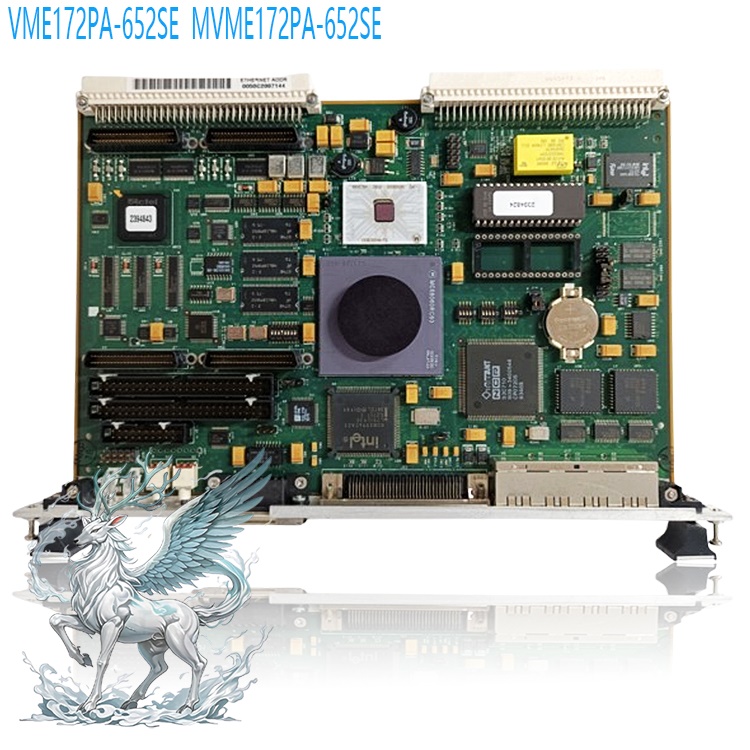
VME172PA-652SE MVME172PA-652SE Other Names:
VME Control Unit Board VME172PA-652SE MVME172PA-652SE
VME172PA-652SE MVME172PA-652SE
VME Bus Embedded Computer
Single-Board Computer
VME172PA-652SE MVME172PA-652SE
Technology
Origin and Standard Status
The
VME (VersaModule Eurocard) bus was primarily developed by Motorola in 1981 and later
became an international standard in the field of industrial control. Its
32/64-bit wide bus architecture supports high bandwidth (up to 400MB/s), low
latency data transmission, and its modular design allows for flexible expansion.
It is widely used in high-reliability scenarios such as military, aerospace, and
industrial automation. Motorola's (now NXP Industrial Controls) VME controller
series has long held a core position in the embedded control market due to its
high-performance processors, industrial-grade design, and rich interface
options.
Core
Positioning and Background
Model
Classification: Belongs to Motorola's (now NXP) MVME172P2 series, a
high-performance single-board computer (SBC) specifically designed for the
VMEbus architecture.
Historical
Development: As a key supporter of the VMEbus standard, Motorola widely used
this model in industrial control, aerospace, and military fields. Later, with
brand integration, NXP inherited the technology.
Technical
Specifications and Features
Processor
and Memory: Utilizes a PowerPC architecture, with a 1.5 GHz clock speed,
equipped with 2GB of DDR3 memory and 16GB of eMMC Flash storage, supporting
high-speed data processing and storage expansion.
Memory
Configuration:
32
MB ECC SDRAM (with error correction support)
2
MB Flash (for firmware storage)
128
KB SRAM (battery buffer, ensuring data retention after power failure)
Interfaces
and Bus:
VMEbus:
Supports A16–32 address space, D08–64 data width, compatible with BLT/UAT/MBLT
transfer modes, controlled by Motorola VMEchip2 ASIC.
Expansion
Interfaces: Two IP (IndustryPack) slots (supports 16/32-bit modules),
integrating SCSI (NCR 53C710 controller), Ethernet (10BASE-T, Intel i82596CA
controller), and four EIA-232-D serial ports (RJ-45, up to 38.4 kbps).
Other
Hardware:
Six
32-bit programmable timers (1µs resolution) + one watchdog timer.
Supports
DMA transfer, remote debugging (e.g., 172Bug/68KBUG tools), and shared memory
multiprocessing.
Industrial-grade
design:
Wide
operating temperature range (-40°C ~ 85°C), adaptable to extreme
environments.
6U
VME standard slot, compatible with industrial bus architectures.
Dual
power supply redundant input (DC 9-36V), with reverse connection protection and
electromagnetic compatibility certifications (e.g., EN55022, EN61000-4-2),
ensuring high reliability.
Bus
and communication: Supports VME bus standard, has system controller functions,
supports D64/A32 bus burst DMA transfer, and is compatible with SCSI, Ethernet,
and other expansion interfaces to meet high-speed data exchange
requirements.
.jpg)
Physical
Parameters:
Dimensions:
261.8mm × 233.4mm × 19.8mm
Power
Supply: +5V (maximum 2A), ±12V (maximum 100mA)
Environmental
Tolerance: -5°C to +55°C operating temperature (forced air cooling), -40°C to
+85°C storage temperature, IP67 waterproof and dustproof rating.
Functional
Highlights and Expandability
High-Performance
Computing: PowerPC processor paired with a floating-point unit (FPU) supports
complex algorithm processing.
Modular
Design: Supports hot-swappable IndustryPack modules, adaptable to I/O expansion,
analog/digital interfaces, and dedicated function modules (such as AD/DA
converters).
System
Management: Built-in real-time clock (RTC) and watchdog timer, supporting remote
reset and status monitoring to ensure stable system operation.
Software
Compatibility: Compatible with embedded operating systems such as VxWorks and
Linux, supports IEC61131-3 standard PLC programming, and is compatible with the
industrial control software ecosystem.
Application
Scenarios and Industry Cases
Industrial
Automation: Factory production line control, distributed data acquisition, PLC
integration, DCS (Distributed Control System) monitoring.
Energy
and Infrastructure: Substation automation (e.g., GE Multilin D20/D200
controllers), power distribution automation (capacitor bank control, fault
location), SCADA system integration.
Specialty
Fields: Aerospace, military communications, medical equipment, nuclear energy
monitoring, telecommunications base station control.
Expansion
Capabilities: Supports I/O modules and analog/digital control modules via IP
slots, compatible with multiple communication protocols (e.g., RS-232, Ethernet,
fiber optic).
Market
Positioning and Advantages
Industry
Status: As the core controller of the VME bus standard, it is widely used in
high-requirement fields such as industrial control, defense, and aerospace, and
is renowned for its high reliability, scalability, and compatibility.
Competitive
Advantages: Compared with similar products, the VME172PA-652SE MVME172PA-652SE excels in wide
temperature adaptability, bus bandwidth, and modular expansion capabilities,
especially in military-grade applications.
Ecosystem
Compatibility: Supports use with Motorola MVME series and VME system chassis
to form a complete embedded control solution.
Classic
Models:
VME162PA-242LE:
Based on MC68EC030/MC68030 CPU, supports VxWorks/pSOS systems, equipped with
2-8MB RAM and NVRAM real-time clock, suitable for industrial automation and test
and measurement scenarios.
MVME333-2:
Equipped with MC68010 CPU,
integrating 6 serial I/O channels
(supporting RS-232/RS-422), equipped with 128KB dynamic RAM and high-speed DMA,
suitable for communication protocol processing and multi-channel data
acquisition.
MVME172P4
Processor:
Optional MC68060 (60MHz) or MC68LC060 (64MHz), integrating 16KB cache and
FPU.
Expansion
Capabilities: 4 IndustryPack slots (supports single-width/double-width modules),
optional SCSI/Ethernet interfaces.
Storage:
16MB SDRAM + 512KB backup battery SRAM, supports NVRAM real-time clock.
.jpg)
Advantages:
Superscalar architecture enables high-performance computing, compatible with
MC68000 code, reducing software migration costs.
MVME162
Series
Processor:
MC68040 (32MHz) or MC68LC040 (25MHz), integrated MMU and FPU.
Interfaces:
VMEbus D64 compatible interface, dual serial ports (RS-232/422), parallel
interface.
Reliability:
Wide temperature range (-40°C to 85°C), ECC memory verification, redundant power
management.
Applications:
Industrial robot control, power monitoring, rail transit signaling systems.
High-Performance
Models:
MVME51005E-0163:
Based on the PowerPC architecture (such as PowerPC 604e), supports a real-time
operating system, equipped with Ethernet/serial/CAN bus interfaces, and has a
wide operating temperature range (-40℃~85℃), suitable for harsh environments
such as military defense and aerospace.
Market
Positioning and Advantages
Motorola
VME controllers are characterized by high-performance computing capabilities,
industrial-grade reliability, and modular scalability, excelling in scenarios
requiring high real-time performance and high reliability. Its long-term stable
supply chain support, extensive industry application cases (such as Siemens,
Lockheed Martin, etc.), and continuous technological innovation (such as the
evolution of VPX/VXS bus) ensure its leading position in the industrial control
field.
Summary:
The MOTOROLA VME172PA-652SE MVME172PA-652SE is an embedded controller designed specifically for
industrial and demanding scenarios. With its powerful computing capabilities,
rich interface expansion, harsh environment adaptability, and mature ecosystem,
it has become a preferred solution in industrial automation, defense, aerospace,
and other fields. Its modular design and high reliability ensure stable
operation and long-term availability in complex systems.


 ABB
ABB GE
GE HONEYWELL
 TRICONEX
 KONGSBERG
 EMERSON
 FOXBORO
 MOTOROLA
 VIBRO-METER
 ICS TRIPLEX
 WOODWARD
 BENTLY NEVADA
 OTHER
OTHER Home
Home.jpg)

.jpg)


.jpg)