Many products have not yet been listed
online; please contact us for information on additional
items.
If there is a discrepancy between a
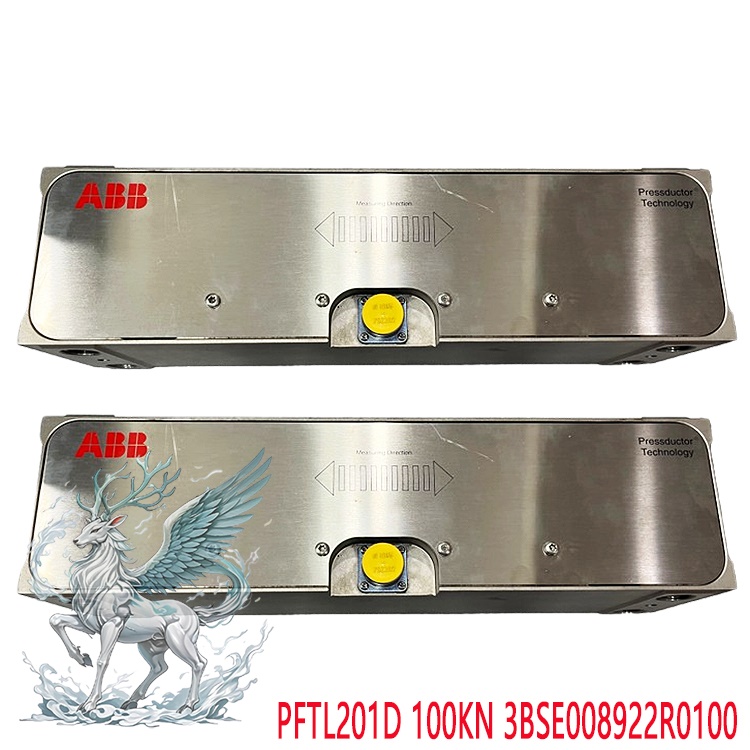
product model and the displayed image, the model number shall take precedence.
Please contact us if you would like to see specific product photos; we can
arrange for them to be taken at our warehouse for your
confirmation.
We operate 76 shared warehouses
globally, so it may occasionally take a few hours to provide you with an
accurate response. We appreciate your patience and will address your inquiries
as quickly as possible.
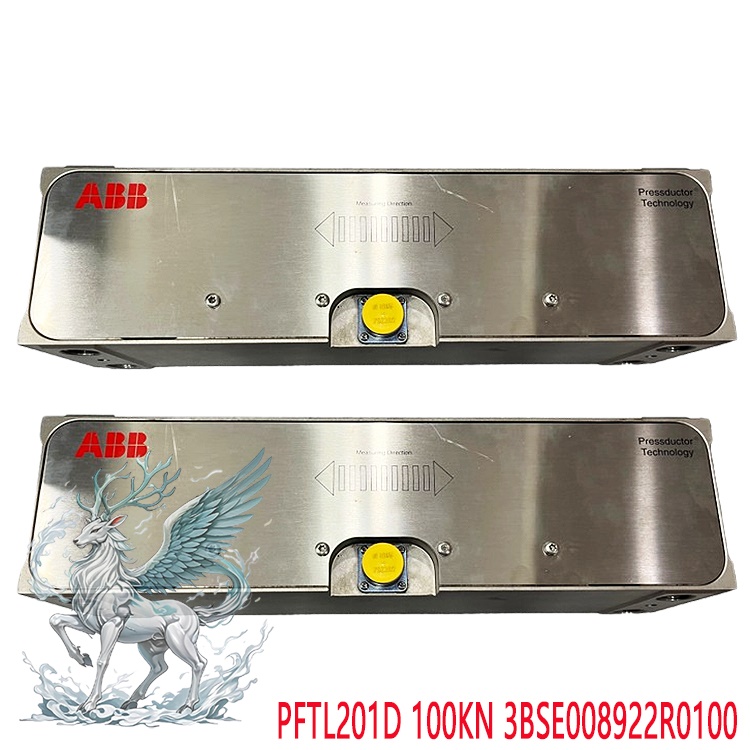
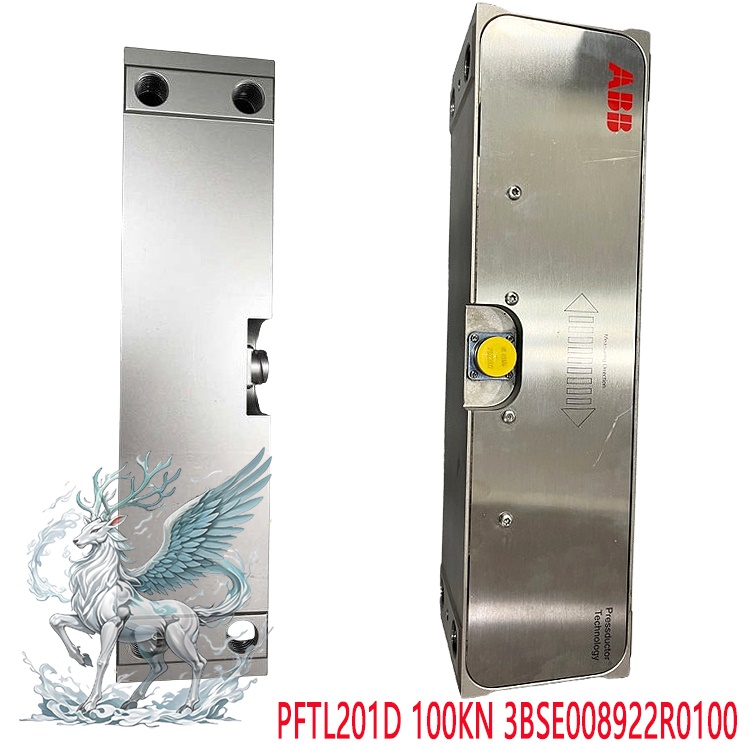
PFTL201C-50KN
– Alternative Designations:
Tension
Sensor
PFTL201C-50KN
PFTL201C-50KN
Horizontal-Measurement Pillow-Block Sensor
Pillow-Block
Sensor PFTL201C-50KN
I.
Operating Principle
The
ABB PFTL201C-50KN tension
measurement system
utilizes ABB’s patented Pressductor® technology, which is based on the
magneto-elastic (pressductor) effect. The sensor consists of a solid block of
specialized alloy steel featuring four internal through-holes, through which two
sets of mutually perpendicular coils are threaded. An alternating current is
supplied to the primary excitation coil, generating an alternating magnetic
field. In the absence of an external load, the magnetic circuits of the two coil
sets are perpendicular to each other; there is no magnetic coupling, and the
secondary (sensing) coil produces no induced voltage output. When tension is
generated during the movement of a strip or web material, this force is applied
to the tension-measuring roller, and the roller housing transmits the mechanical
load to the magneto-elastic sensor body. As the steel material is subjected to
mechanical force, its internal magnetic permeability changes, causing a shift in
the magnetic field distribution. This results in partial coupling of the primary
magnetic field into the secondary coil, which then generates an induced AC
voltage signal. The magnitude of this voltage signal is linearly proportional to
the applied load. The sensor’s output signal is transmitted to a tension
amplifier unit, which performs filtering, amplification, and temperature
compensation. The signal is then converted into a standard analog output and
sent to a PLC or tension
controller. This enables real-time calculation of web tension, facilitating
closed-loop tension regulation and ensuring stability across the production
line. Unlike strain-gauge sensors—which rely on physical deformation—these
sensors undergo only minimal (micrometer-level) deformation, resulting in
superior resistance to fatigue and impact.
II.
Core Product Advantages
High
Measurement Accuracy and Long-Term Stability: The system achieves a measurement
accuracy of up to ±0.5% with minimal signal drift. Its magneto-elastic
(press-magnetic) design eliminates the fatigue and aging issues associated with
strain gauges, removing the need for periodic recalibration. This significantly
reduces on-site maintenance requirements and ensures stable, reliable data
during long-term, continuous operation.
Exceptional
Overload Capacity and Impact Resistance: Capable of withstanding short-term
overloads of up to 10 times the rated load, these sensors are highly durable and
well-suited for demanding conditions, such as production line start-ups,
shutdowns, or the sudden impact caused by a strip break. The minimal deformation
of the sensor body ensures a long fatigue life, making it ideal for applications
involving high-frequency, reciprocating loads.
Strong
Interference Resistance for Harsh Industrial Environments: The sensor outputs a
low-impedance AC signal, providing excellent immunity to electromagnetic
interference. Its integrated stainless-steel construction offers a high level of
protection, allowing it to withstand dust, humidity, temperature fluctuations,
and vibration—making it suitable for the most rigorous industrial environments,
such as those found in metallurgy or papermaking.
Compact
Design and Flexible Installation: Featuring a "pillow-block" (cradle-style)
load-cell design, the sensor can be installed directly beneath the
tension-measuring roller's bearing housing. It isolates and measures only the
tension component, automatically excluding the weight of the roller itself to
ensure accurate, true-to-life readings. It supports both horizontal and vertical
mounting, making it ideal for both new installations and the retrofitting of
existing production lines.
Excellent
Signal Compatibility for Automation Systems: The accompanying tension amplifier
provides a standard industrial output signal, allowing for seamless integration
with PLCs, DCS, variable-frequency drives (VFDs), and tension controllers. This
enables easy incorporation into existing automation control systems to achieve
automatic, closed-loop tension regulation.
III. Relevant Industries and Applications
1.
Metallurgical Industry (Cold Rolling, Hot Rolling, Pickling, Galvanizing, and
Aluminum Foil Production Lines)
Function:
Provides real-time tension monitoring during the rolling of steel strips, copper
strips, and aluminum foil. It stabilizes strip tension, preventing issues such
as strip deviation, breakage, wrinkling, and uneven thickness. This improves
surface quality and dimensional consistency, while reducing downtime caused by
strip breakage.
2.
Paper Manufacturing and Processing Industry
Function:
Monitors tension during the forming (wire section), pressing, rewinding, and
slitting processes. It maintains constant paper tension, preventing tearing or
wrinkling, improving paper flatness, reducing downtime due to paper breaks, and
enhancing the operational efficiency of paper machines.
3.
Film, Coating, Printing, and Lamination Industries
Function:
Used in the processing of plastic films (such as BOPP and PET), flexible
packaging printing, lamination, and coating. It stabilizes film tension,
preventing stretching, deformation, or thickness variations. This ensures high
precision in multi-color printing (registration) and increases the yield rate of
finished laminated products.
4.
Textile and Chemical Fiber Industries
Function:
Applied to production lines for chemical fiber filaments, non-woven fabrics, and
the tentering/setting or slitting of textiles. It monitors the tension of
fabrics and filaments, preventing stretching, deformation, or fiber breakage,
and ensuring consistent dimensions in the final products.
5.
Cable and Steel Wire Rope Industry
Function:
Used in the production lines for optical cables, electrical cables, and steel
wire stranding. It monitors the tension of conductors and steel wires,
preventing wire breakage or fluctuations in cable diameter, and ensuring that
the finished cables meet required mechanical performance standards. General
Industry Value: Real-time acquisition of web tension provides precise feedback
to the control system, enabling closed-loop constant tension control. This helps
reduce product defects—such as web breaks, mistracking, wrinkling, and
dimensional deviations—while minimizing production line downtime, increasing the
yield of finished products, reducing raw material waste, and enhancing the
overall automation level of the production line.
IV.
Standard Operating Procedures
4.1
Pre-installation Inspection
Upon
unboxing, inspect the sensor unit, cables, and connectors to ensure they are in
good condition, free from dents or cracks. Verify the model and measurement
range to ensure they match the specific on-site operating conditions. Clean the
contact surface of the mounting base to ensure it is flat and free of
debris.
4.2
Equipment Installation
Install
the PFTL201C-50KN pillow-block tension sensor beneath the bearing housing of
the tension-measuring roller. Tighten the mounting bolts evenly according to the
manufacturer’s specified torque; do not tighten one side excessively before the
others. Route the dedicated shielded cables away from power cables to minimize
electromagnetic interference. Ensure sufficient slack in the cables to prevent
them from being pulled or strained by roller vibrations. Properly seal all
connectors to ensure protection against water and dust.
4.3
Wiring and Commissioning
Connect
the sensor to the tension amplifier according to the wiring diagrams, and verify
that the supply voltage is correct. Once wiring is complete, check the
insulation of the circuits to prevent short circuits. Perform a zero-point
calibration (tare) while the system is unloaded to eliminate any zero-point
offset caused by the weight of the roller itself. If necessary, perform a range
verification using standard calibration weights.
4.4 Commissioning and
Operation
Conduct
a no-load test run, ensuring that tension readings remain stable without erratic
fluctuations. Start the production line at a low speed and gradually increase it
while monitoring real-time tension values; coordinate with the controller to
perform PID parameter tuning. Observe tension fluctuations throughout the
acceleration, deceleration, and steady-state operation phases to verify the
stability of the closed-loop control.
4.5
Shutdown Procedures
For
a standard shutdown, first reduce the production line speed, then stop the main
equipment. For long-term shutdowns, disconnect the power supply to protect the
sensors and signal modules.
V.
Precautions for Use
Do
not strike or impact the sensor body. As a precision force-measuring component,
the sensor contains internal magneto-elastic elements that can suffer permanent
damage from impacts, leading to measurement failure.
Keep
the operating load within the rated range; brief overloads are permissible, but
continuous long-term overloading is prohibited to prevent permanent damage to
the sensor.
Use
shielded cables for all wiring and route them away from strong interference
sources, such as variable frequency drives (VFDs) or high-power motors. Ensure
that cable connectors remain dry and sealed to prevent the ingress of moisture
or oil, which could cause signal irregularities.
Perform
regular inspections: check for loose mounting bolts, worn cable insulation, or
corrosion on connectors. Clean dust and oil from the sensor surface; do not use
high-pressure water jets directly on the sensor body.
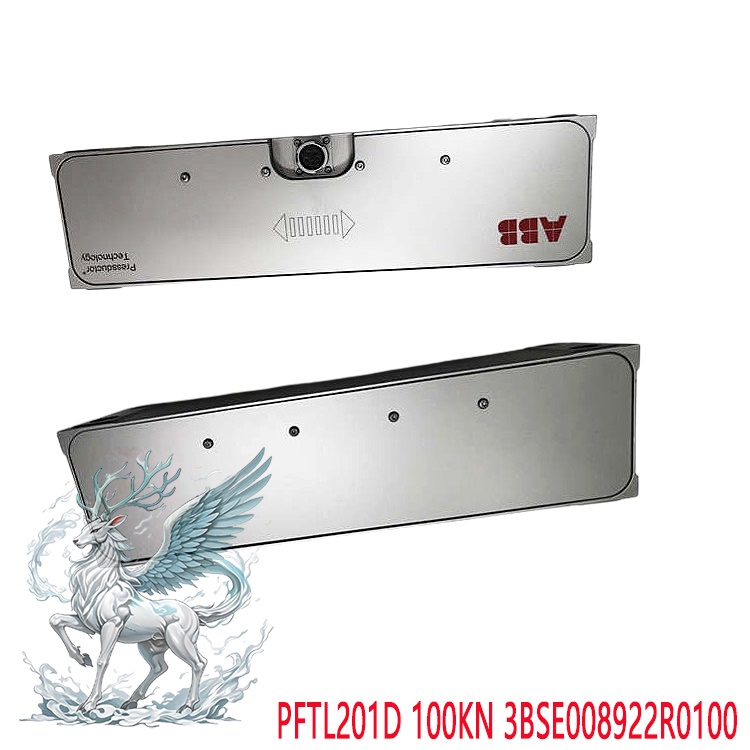
Ensure
the force is applied in the correct direction during installation. Avoid lateral
(side) loading, as this introduces measurement errors and compromises the
accuracy of tension readings.
Do
not attempt to disassemble the sensor. It contains a precision magneto-elastic
steel structure; disassembly will render the unit unusable. For repairs or
calibration, please contact an authorized ABB service provider.
In
high-temperature or corrosive environments, implement appropriate protective
measures to prevent chemical agents from corroding the sensor’s stainless steel
housing. In the event of abnormal zero-point drift, prioritize checking the
installation, cabling, and grounding; do not perform repeated, arbitrary
calibrations. This product is designed to be maintenance-free
(calibration-free); frequent calibration may mask underlying on-site issues.
Recommended
products:
3BHE029063R0101
PAD238 A101
3BHE041626R0101
PDD405
3BHE041626R0101
PDD405A101
8R37-2021-21-3101
PCD2000
3BHE032025R0101
PCD235
3BHE022293R0101
PCD232A
3BHE042816R0101
PCD244
3BHE022291R0101
PCD230
More......


 ABB
 GE
 HONEYWELL
 TRICONEX
 KONGSBERG
 EMERSON
 FOXBORO
 MOTOROLA
 VIBRO-METER
 ICS TRIPLEX
 WOODWARD
 BENTLY NEVADA
 OTHER
 Home
.jpg)
.jpg)